
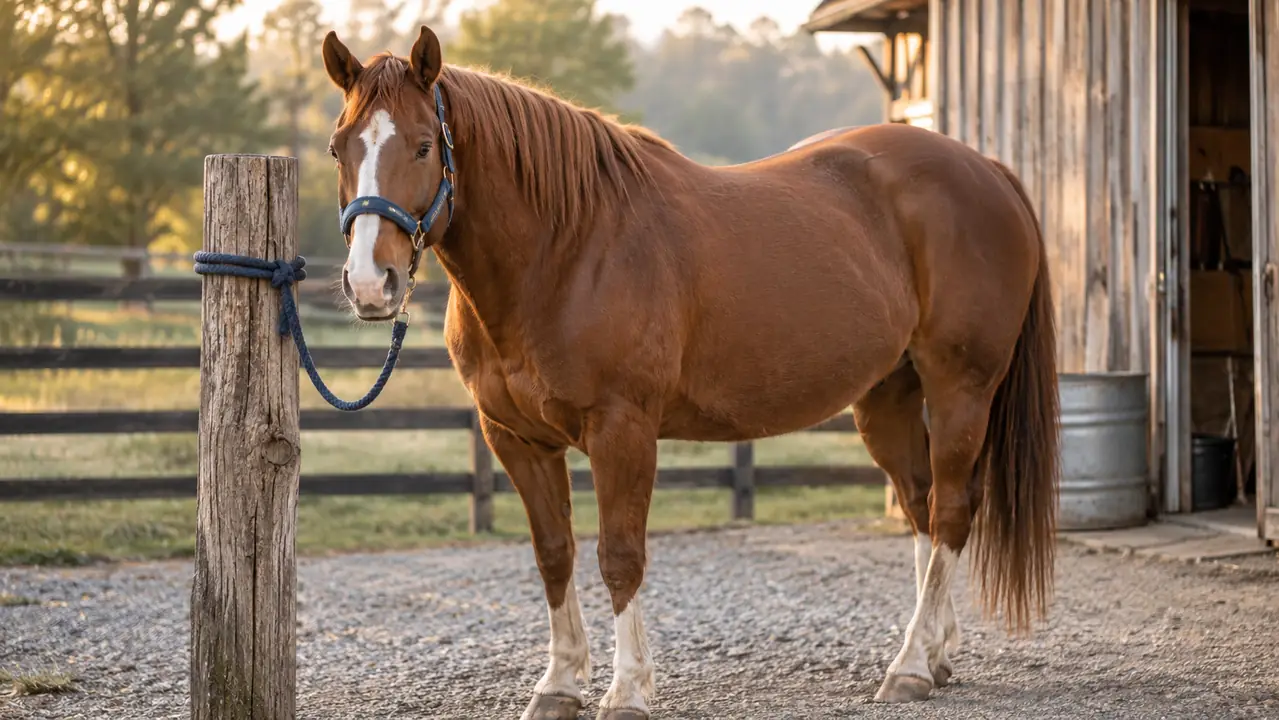
The halter on the hook by my barn door has been on and off Ranger's head twice a day for two years. I bought the Weaver Equine padded nylon halter in November 2024, Average Horse size, one inch wide, and it has been the only halter I have used since. Not out of brand loyalty. Out of laziness, mostly, and because nothing on it has given me a reason to go buy something else. The four halters before it did. Every one of them failed the same boring way: buckles that turned orange by spring, nylon that frayed where it met the cheek, and a noseband that rubbed the hair off a horse's face by August. I got tired of buying a new one every year.
I am not a trainer and I do not play one on the internet. I am 61, retired after 28 years carrying mail on rural routes, and I ride one horse: Ranger, a 15-year-old sorrel Quarter Horse gelding, about 1,050 pounds and 15.1 hands. We do Forest Service trails and gravel roads outside Harrison, Arkansas, three or four rides a week in good weather. He wears a halter for catching, grooming, tying, the farrier and loading in the trailer, and for nothing else. He is never turned out in one and never stalled in one, because that is how horses get hurt. I tie him with a quick-release knot, always. So this is a narrow review on purpose: one halter, one horse, two years.
The Quick Verdict
Two years of daily handling, one hand wash in spring and one in fall, and nothing has failed. The padding is flatter than new and the nylon has faded. The brass plated hardware still works and the stitching still holds. A plain, well-built halter that outlasted every cheap one before it.
Amazon Check Today's Price →The halter I stopped replacing every spring
Two years on one horse, and the stitching, the snap and the brass plated hardware are all still doing their jobs. If you are tired of buying a feed-store halter every March, start here and check today's price.
Amazon Check Today's Price on Amazon →How I've Used It
The halter came out of the box in November 2024 and went on Ranger's head the same afternoon. I set the noseband and the crown where they needed to sit, buckled everything down, and checked that I could slide two fingers under the noseband without a fight. Then I did not move it again. That was two years ago. The adjustments have stayed exactly where I put them, which sounds like a small thing until you have owned a halter whose buckles creep a notch every couple of weeks until the fit is wrong and the rub starts.
In daily use it goes like this. I walk out to the pasture, catch Ranger, lead him in with the halter, tie him at the post with a quick-release knot, and groom him. He stands tied for our farrier every six to seven weeks. Once a month or so I load him in the two-horse bumper-pull behind my pickup for a longer trail ride with friends, and the halter goes on for loading and comes off at the other end. Then it hangs back on the hook. That is the whole life of this halter: catch, lead, tie, groom, farrier, trailer. Somewhere north of 1,400 times on and off his head, by my rough arithmetic.
Before it, I was on the every-spring plan. A cheap nylon halter from the feed store in March, faded and stiff by October, and a buckle that left rust streaks on my hands by the next spring. The last one frayed through at the cheek strap where it rubbed against the post when Ranger leaned. I did not trust it after that. It is still in a bucket in the tack room as a spare and I would not put it on him to lead him twenty feet.
The first week I owned the Weaver Equine halter I did what I always do with new tack: I checked it every single time I put it on. I ran my thumb along the stitching at the cheek, looked at where the padding met the nylon, and pulled on the snap to see if it felt loose. By the second week I had stopped checking. That is the highest compliment I can pay a piece of tack. I have not had a reason to look twice at it since, and the bucket of dead halters in the tack room is the reminder of what that used to feel like.
What the Padding Does After Two Years
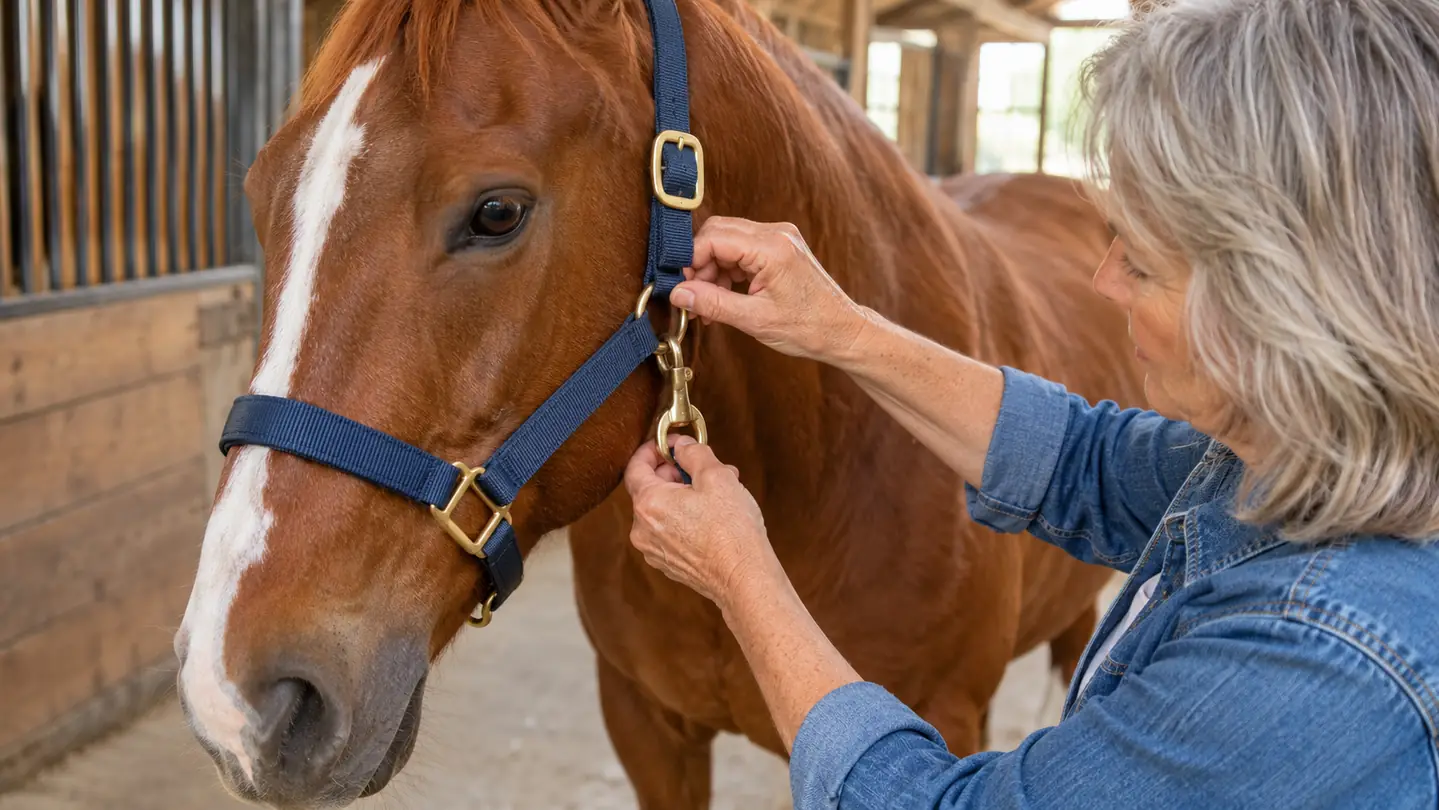
The noseband and the crown are lined with a soft PVC-coated foam rubber, and that lining is the reason I bought this halter instead of another plain nylon one. Ranger sweats hard in an Arkansas summer, and bare nylon against wet hair is a rub waiting to happen. The padding sat between the nylon and his face and took the wear instead of his skin.
Two years in, the padding is flatter than it was out of the box. It has compressed where the noseband crosses his face and where the crown sits behind his ears. What it has not done is crack, crumble, or peel loose from the nylon. I have pinched and pulled at it looking for a split and have not found one. The hair on his face is intact, and that is the whole test. On the halter before this one he had a bald stripe across his nose by late summer every year, and it grew back every winter.
I wash the halter by hand in the spring and again in the fall, in a bucket of warm water with a little soap, working the padding with my thumbs and rinsing it well. Then it hangs in the sun to dry. I do not put it in the machine and I would not. The padding has stayed attached through two washings a year for two years, and I expect it will keep doing that.
Brass Plated Hardware and a Snap That Still Snaps
The hardware is brass plated, and it is worth saying plainly that brass plated is not solid brass. On cheap halters the plating is the first thing to go, and once it goes you get rust bleeding into the nylon and onto your hands. On this one the plating is still intact after two years, and I have not had a single rust stain on my palm.
The closure is a snap, and it still snaps with a solid click. That matters more than it sounds in February, when my fingers are cold and stiff and I am holding a lead rope in the other hand. I can open and close this halter one-handed with a glove on. I could not do that with the last halter, whose buckle needed two hands and a fair amount of muttering.
I would keep an eye on plating wear on any halter, because plated hardware wears eventually, no matter who made it. Mine has not worn through. I check it when I wash the halter, and if it ever does wear through I will know, because the nylon underneath will start to stain.
Sizing: What Average Horse Meant for Ranger
Ranger is 15.1 hands and about 1,050 pounds, and the Average Horse size is where he lands. The halter is one inch wide, which is a good middle weight for a horse his size: wide enough not to cut, narrow enough that it does not feel like a draft halter on him. Weaver Equine builds this one for average-sized breeds, and a Quarter Horse is about as average as it gets.
I measured Ranger's head the way I have measured every head for years: a soft cloth sewing tape, run around the nose just above the nostrils, then up over the poll behind the ears. I wrote both numbers on the back of a feed receipt and took it to the size chart instead of eyeballing it. Then I fitted the halter with two fingers of room under the noseband and one behind the crown, and made sure the buckle did not sit against his cheekbone where it would press. That is fifteen minutes of work, once. It is the reason I have not had a rub in two years.
There is still strap left on both sides of the buckle on every adjustment, with a 1,050-pound horse and two years of use on it. So there is room in this halter for a bigger horse than mine, or for a winter head. If your horse falls between Average Horse and the next size up, measure his head with a soft tape and follow the size chart rather than guessing. Guessing on halter size is how you end up with a rub, and a rub takes all winter to grow back.
What Two Years in Arkansas Weather Did to It
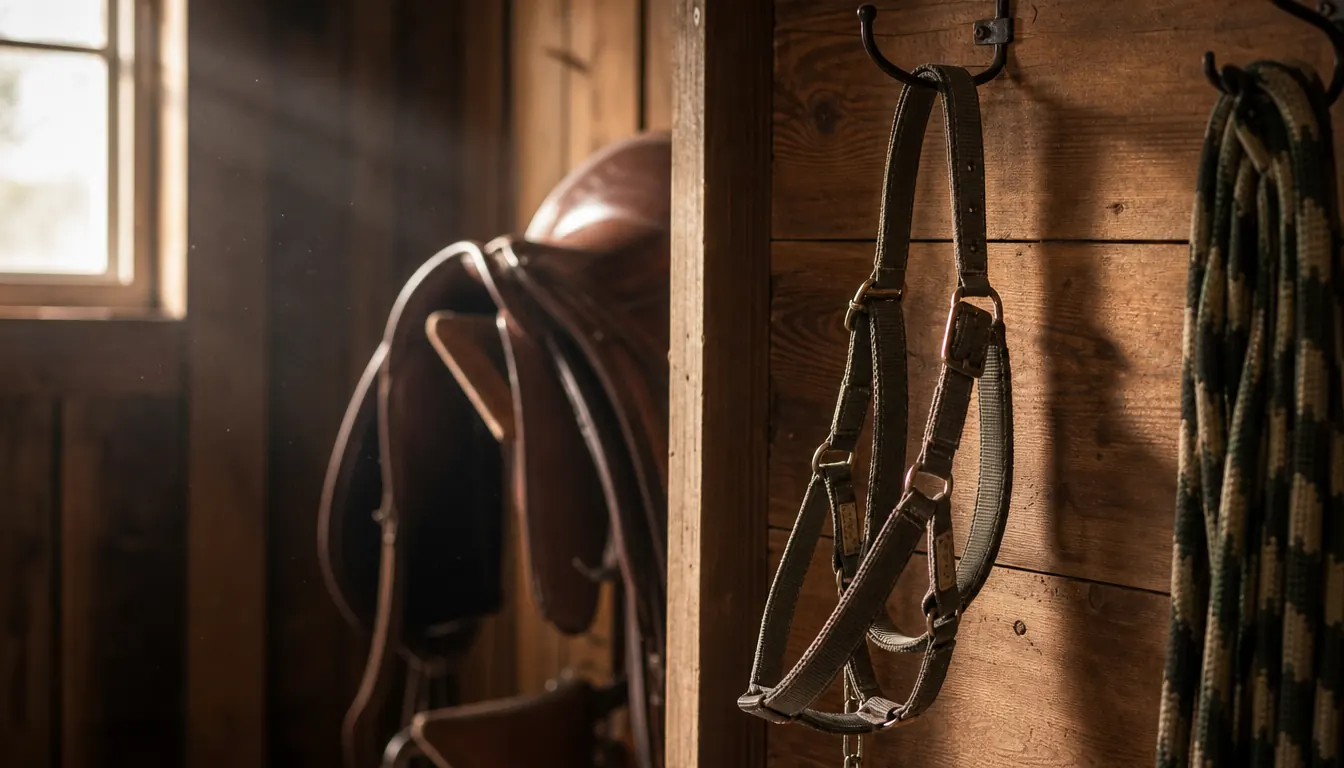
It has faded some. That is honest: two years of sun and sweat and rain, hanging in a barn aisle, will fade any nylon. The nylon has also gone a little softer at the cheek where it folds through the snap, which in my book is a good thing, because new nylon is stiff and stiff nylon rubs.
August is the real test out here. Last August I had Ranger tied at the post after a ride, sweat running down his face and neck, and the halter was soaked through. I hung it on the hook still damp and it dried that way in the barn aisle overnight. It did not stiffen up, and it did not smell like a wet dog the next morning the way cheap nylon does.
What has not happened is the list I used to expect. No stitching has let go. No hole has worn through at the cheek or the crown. The snap has not loosened. Nothing has stretched out of shape, and the adjustments are still where I set them in November 2024. Those are the five things that ended every halter before this one.
The one small thing I notice is that the very edges of the nylon have roughened slightly where they rub against the post when Ranger leans on the tie. It is cosmetic. In two years of leaning, and he leans a lot, it has not frayed into the body of the strap. I keep an eye on it when I wash the halter, and I will say so here if it ever changes.
What I Would Change
Two things, and neither is a dealbreaker. I would pay more for solid brass hardware instead of brass plated, because solid brass outlives plated and I would rather buy once. And I would like the padding on the noseband a touch thicker, since it has flattened where it crosses his face, though it has not worn through and it has not rubbed him.
That is the list. Two years, every day of handling, and those are the only two things I can find to want different. It is not a complaint. It is a wish list for a version that does not exist.
What I Liked
- PVC-coated foam rubber padding has not cracked, peeled or rubbed the hair off after two years
- Brass plated hardware is still intact with no rust bleeding onto hands or nylon
- Snap closure works one-handed with a glove on
- Adjustments have held their setting since the first fitting
- No failed stitching, no stretched holes, no frayed cheek strap
Where It Falls Short
- The padding has flattened where the noseband crosses the face
- Nylon has faded and the strap edges have roughened slightly at the tie point
- Hardware is brass plated, not solid brass
Somewhere north of 1,400 times on and off his head, and the stitching has not let go, the snap still snaps, and the buckles still sit where I set them in November 2024.
Who This Is For
Somebody with one average-sized horse who is tired of buying a halter every spring. Somebody who wants a halter that lives on a hook and gets used twice a day for catching, tying, grooming, the farrier and trailering. Somebody whose horse sweats and rubs and needs padding between the nylon and his face. Somebody who wants a snap they can work with cold hands at six in the morning. If you are any of those, the Weaver Equine padded nylon halter is the one I would hand you, and I would tell you to fit it once and then leave it alone.
I would also hand it to someone keeping tack in an unheated barn who does not want to fuss over it. Mine has been rained on, sweated through, hung up wet, and washed twice a year, and it has never asked for anything more than that from me. No oil, no conditioner, no taking it apart to clean underneath. It also suits a barn where tack gets put away damp, because a hand wash and a line in the sun is the whole maintenance routine.
Who Should Skip It
Skip it if you are shopping for a horse well outside the average range. This listing is the Average Horse size, and if yours is a pony or a draft, measure him and buy the size that actually fits rather than making this one work. Skip it if what you want is a rope halter for groundwork and leading a pushy horse, because that is a different tool for a different job, and padded nylon is not it.
Skip it if you want leather, or if you want a halter with a breakaway link. And skip it, honestly, if you are the sort who leaves a halter on in turnout. No halter is safe left on an unattended horse, and this one is no exception. That is not a fault in the halter. It is how halters work.
If none of that describes you, and you just want the everyday halter to stop being an annual expense, this is the one that ended that cycle for me.
Two years, one horse, and no reason to replace it yet
Padded against a sweaty face, brass plated hardware, a snap I can work with gloves on, and stitching that has held through two years of daily handling. Check today's price, and measure your horse's head before you order.
Amazon Check Today's Price on Amazon →