
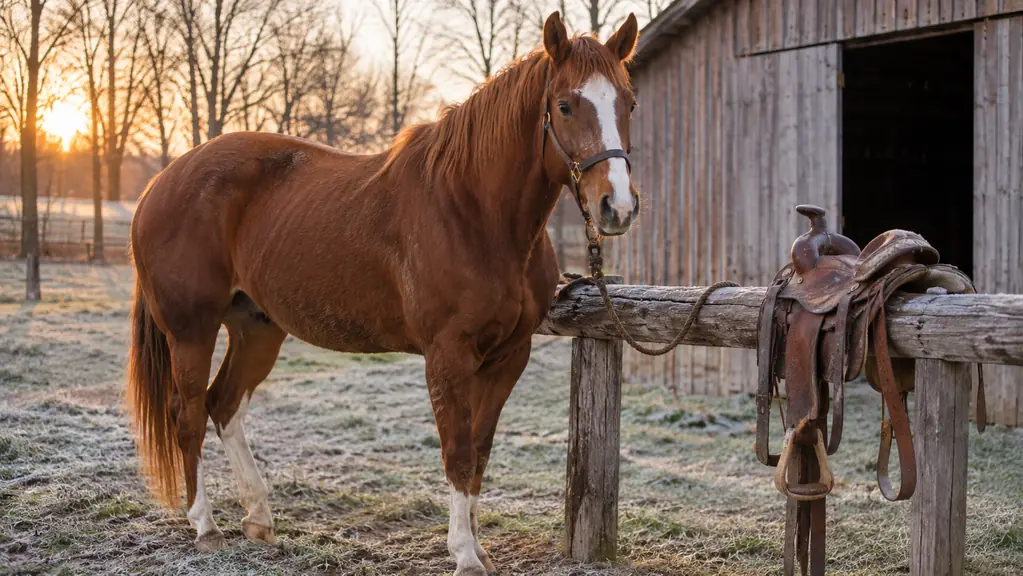
The first thing I want to say about the Weaver Equine padded nylon halter is that there is nothing interesting about it. It does not do anything clever. Nobody at the barn has ever asked me where I got it. I bought it in November 2024 because the feed-store halter I had bought the year before had rusted buckles and a cheek piece that was already fraying, and I was tired of buying a new one every spring. Two years later that is still the entire story. It is a plain one-inch nylon halter with padding and a snap at the throat, and it has been on Ranger every single time I have handled him since.
Most halter reviews read like the back of the package. This one will not. I am going to tell you what fit and what did not fit right away, what two Arkansas summers have done to the padding, what has held, and the two small things about it that still annoy me after two years of daily use. If you are shopping for a halter for an average-sized horse and you want to know whether this one is worth stepping up from the bargain bin, that is exactly what this is. I am not a trainer and I am not selling anything. I am a retired mail carrier with one horse and a hook in the tack room.
The Quick Verdict
A plain, honestly built padded nylon halter that has survived two years of daily handling on a 1,050 pound Quarter Horse. The padding compresses and the nylon fades, but no stitching has failed and no hardware has rusted out. Worth the step up from a feed-store halter.
Amazon Check Today's Price →One Halter, Two Years, No Failed Stitching
I have bought five halters in the last decade. This is the only one that made it past two winters without a rusted buckle or a split seam. If you are tired of replacing one every spring, this is the one I would buy again.
Amazon Check Today's Price on Amazon →What Nobody Tells You About a Plain Nylon Halter
Every halter listing says padded. Almost none of them tell you what the padding is made of, and that is the part that decides whether the thing is comfortable in July or turns into a sponge. This Weaver Equine halter uses a soft PVC-coated foam rubber liner under the nylon. The coating is the reason I bought it. The cheap halters I used to buy had a fuzzy fabric wrap over open foam, and after a summer of sweat and rain that wrap held water, went stiff, and started to smell like the bottom of a bucket no matter what I washed it with. The coated liner on this one wipes clean with a rag. Two summers in, it is flatter than it was, but it has never gone crunchy and it has never held a smell.
The second thing nobody mentions is the hardware. Brass plated is not the same as solid brass, and I want to be straight about that rather than let a listing photo do the talking. Brass plated buckles on a nylon halter will still dull and darken. What they will not do, in my experience, is pit and seize the way the thin plated buckles on a bargain halter do. Mine have gone a dull brown over two years. They still open with one hand, and I have never had to work one loose with a screwdriver, which I did twice on the halter that came before this one. For a piece of gear that lives outdoors half the year in Arkansas humidity, that is the difference that matters.
The third thing is the width. This is a one-inch halter, which is the right middle ground for a horse Ranger's size. I once used a three-quarter inch halter and it cut into him behind the ears the one time he set back on the lead. I have also handled a friend's draft halter with much wider straps, and on a 1,050 pound horse that is simply more strap than the job calls for. One inch spreads the pressure without adding bulk. If you have a pony, a fine-boned young horse, or a big draft cross, one inch may not be your width. Weaver Equine builds this halter in other sizes, so measure your horse rather than guessing.
How Ranger Has Actually Worn It
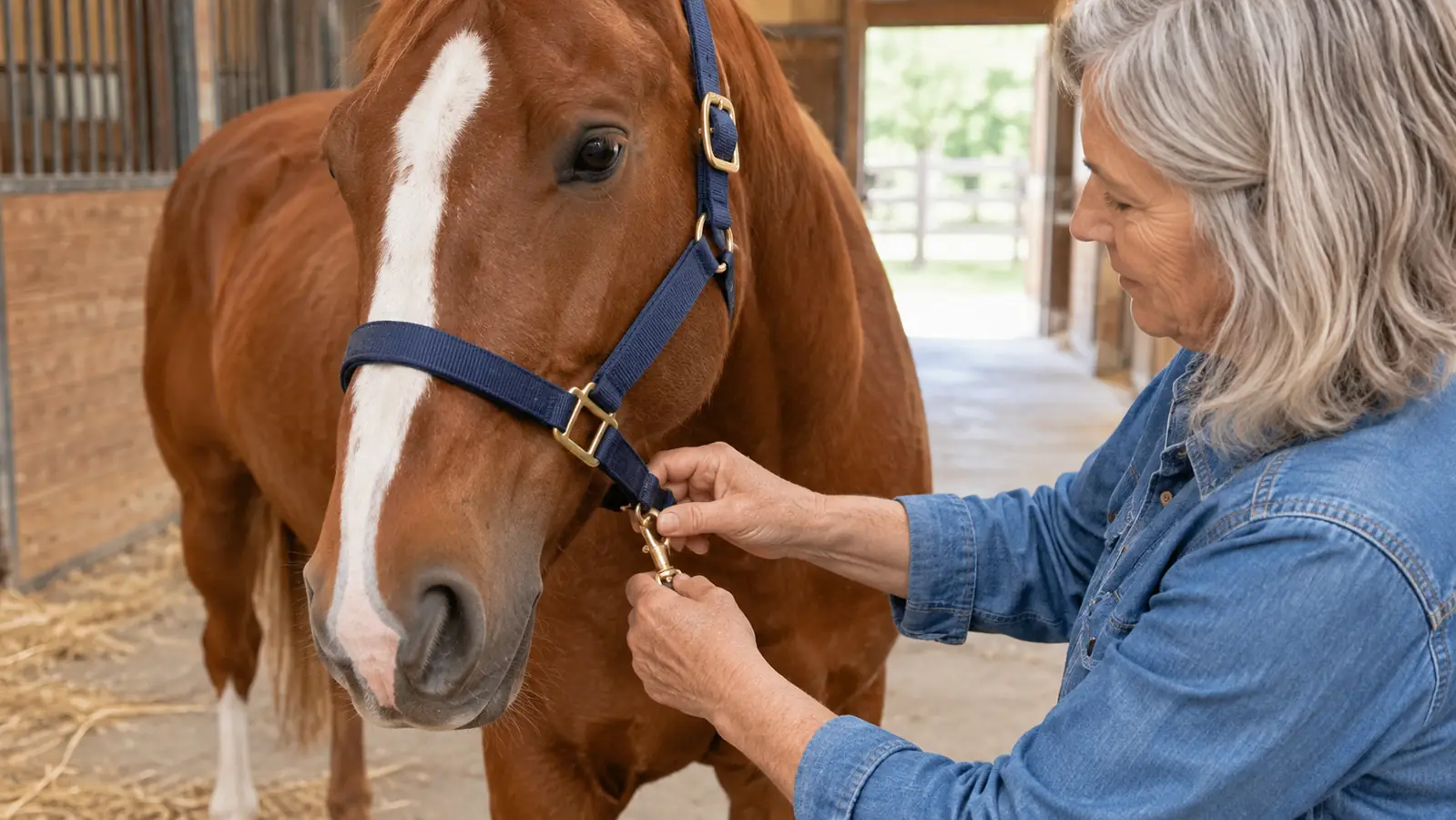
Ranger is a 14-year-old sorrel Quarter Horse gelding, 15.1 hands, about 1,050 pounds, with a white blaze and one white sock on the left hind. I have had him six years, bought him from a neighbor when he was eight. He is calm on the trail and a little herd-sour about leaving the barn, and he will set back on a lead rope if he thinks he is being left behind. He wears this halter for catching, for grooming, for tying, for the farrier, and for loading in the trailer. He does not wear it in the pasture and he does not wear it in a stall.
That last part is not a knock on the halter. It is how I was taught and how I still do it. A halter left on a turned-out horse is how you end up with a horse hung up on a fence post, and I have seen it happen to a neighbor's gelding. When I tie, I tie with a quick-release knot to a post or a trailer tie, never hard and fast to something he can pull against. Given all of that, this halter has gone on and come off Ranger four or five times a day in riding season for two years. That is a lot of snaps and a lot of buckling, and that repeated handling is what actually tests a halter, not the look of it hanging on a shelf.
Farrier day is the real test. Ranger's farrier comes every six to seven weeks because he is shod in front only, and Ranger is not above leaning on a person while his feet are being done. The halter has to hold him without galling him, and I have to be able to get it off quickly if he gets fussy about a hind foot. The padding is the piece I notice most on those days. Even now, with the liner pressed flat, I have not found a rub mark or a bare patch of hair where the noseband sits. Our farrier has commented on it twice, and he is not a man who hands out compliments on tack.
Two Arkansas summers of sweat, rain and trail dust have faded the nylon and flattened the padding. No stitching has let go and no buckle has seized.
Fit and Hardware, Up Close
Ranger takes the Average Horse size in a one-inch width, and he fits comfortably in the middle of the adjustment range rather than on the last hole, which is what you want. A halter that only fits on the very last hole is a halter that is the wrong size, and I have made that mistake before. This one adjusts enough that I set it where I wanted it, roughly two fingers below his cheekbone at the nose, and then left it alone. I have re-evened it after washing, twice a year, and that is the only time I have touched the adjustment since the winter I bought it.
The throat closes with a snap, and I will say plainly that the snap is my favorite part and also the part I expect to fail first. It is one-handed, which matters in February with gloves on and a horse dancing at the gate. After two years of daily use it still closes with a clean click and no wiggle. But any snap is a moving part, and moving parts wear out. If this halter ever dies, I expect it will be the snap, not the nylon and not the stitching. I keep a spare lead rope in the trailer for exactly that kind of failure, and I would suggest you do the same no matter whose halter you buy.
The buckles are brass plated and they open and close with one hand. My one real complaint about the fit is that the strap ends are longer than they need to be once the halter is adjusted down to Ranger's size. I have a few inches of tail on each side that I tuck away and forget about. It is not a defect. It is nylon that Weaver Equine left long enough to fit a bigger head than his, and I would rather have that than a halter I cannot adjust at all. Earl laughed at me for noticing it, and then he noticed the same thing on his own belt, so there you go.
Two Years of Wear, Honestly
Here is the unglamorous truth. The halter has faded. It has gone from a solid color to a lighter version of itself, which is what nylon does when it lives in the Arkansas sun and gets rained on. It has also picked up a gray film in the weave that no amount of washing takes out, mostly trail dust and dried sweat. That is cosmetic and it does not bother me. I hand wash it in the spring and again in the fall in a bucket of warm water with a little mild soap, rinse it well, and hang it over the fence to dry out of direct sun. That routine takes ten minutes twice a year and the hardware has thanked me for it.
The padding has flattened. That is the honest con, and it is the thing I would most want to know if I were reading this instead of writing it. The liner is noticeably thinner and softer than it was in the winter of 2024, especially where the noseband sits. It has not torn, it has not separated from the nylon, and it has not started to crumble the way open foam does when it gets wet and dries out a hundred times. It is simply compressed. Ranger has not shown me a rub, and I check behind his ears and under his jaw every time I take it off. If you have a thin-skinned horse or one that reacts to steady pressure, plan on replacing the halter when the padding gets this flat rather than when the stitching fails.
The stitching has held everywhere. I have tugged at the stitched joints at the buckle ends and at the noseband, and I have found nothing loose and no pulled thread. The brass plated hardware is dull but functional. No rust pitting, no seized buckles, no snap that has gone soft. For comparison, the two feed-store halters I bought in 2022 and 2023 both failed inside eighteen months, one at a cheek piece seam and one at a rusted buckle that I had to cut off with a pocketknife in the trailer. That is the whole case for this halter. It is not that it is fancy. It is that it is still hanging on the hook.
What I Liked
- PVC-coated foam rubber liner wipes clean and does not hold sweat or odor
- One-inch nylon width suits an average-sized horse without bulk
- Brass plated hardware has not rusted or seized in two years of outdoor use
- Adjustment range is generous enough to fit mid-range rather than on the last hole
- Stitching at the buckle ends and noseband joints is still intact after daily handling
- Throat snap works one-handed with gloves on
Where It Falls Short
- Padding compresses noticeably over two years of daily use
- Nylon fades and holds trail dust in the weave
- Strap ends are long once adjusted to a smaller head
- The snap is a moving part and will likely be the first thing to fail
- Not a breakaway design, so it is not for turnout
The Tradeoffs Nobody Mentions
This is a handling halter, not a turnout halter. Nylon does not give under load the way leather does, so if you are looking for something to leave on a horse out in the pasture, this is the wrong tool and I will not pretend otherwise. The same applies if you are buying a first halter for a young horse and you want a breakaway. Buy the breakaway. Come back to this one when the horse is handling well and you need something that will still be sound in three years. I would rather tell you that now than have you learn it from a wreck.
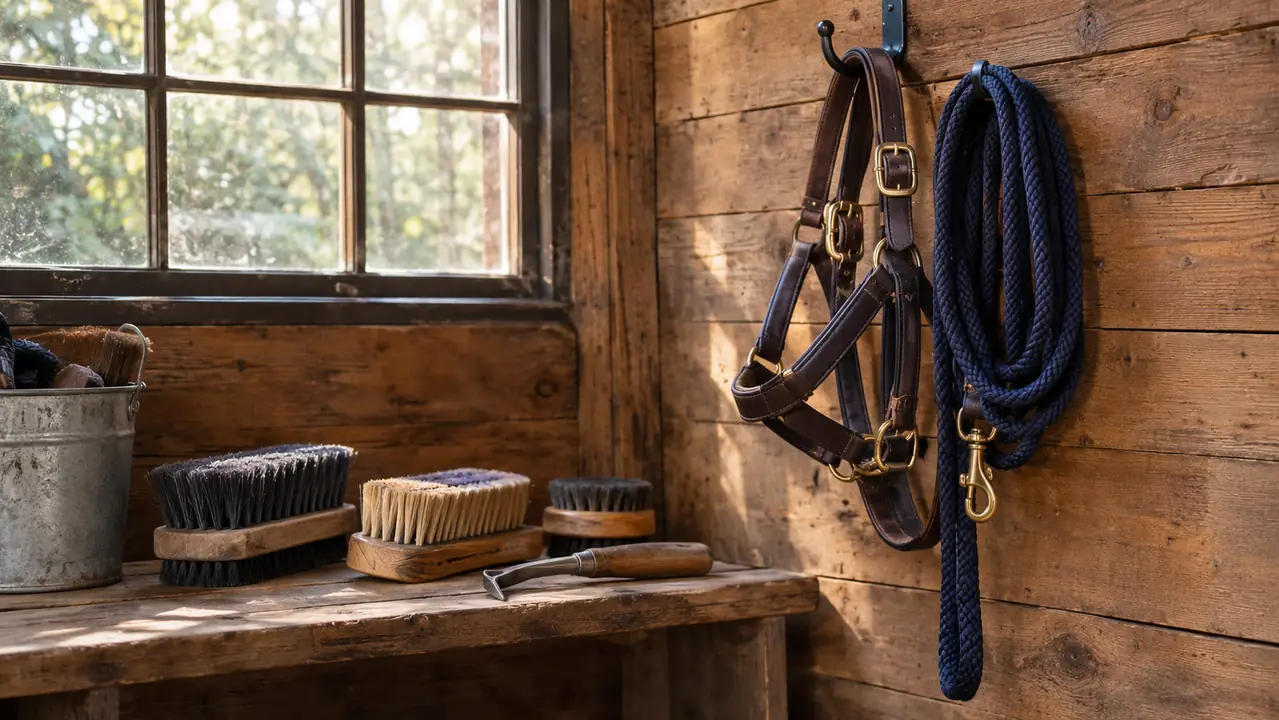
It is also not a show halter and it is not a groundwork halter. A friend of mine does groundwork in a rope halter because she wants the sharper feedback through the lead rope, and that is a real difference and a fair reason to choose something else. Rope gives a horse a quicker signal. This padded nylon gives a softer one, which is what I want on a trail horse I am catching in the dark on a November morning. Different jobs, different tools. If you are weighing the two, weigh them on what you actually do with your horse, not on what looks tidier in the tack room.
Who This Is For
This halter is for the person with one average-sized horse who is tired of buying a halter every year. If your horse is somewhere around 1,000 to 1,100 pounds, the kind of animal that falls in the middle of a size chart, and you want a halter that lives on a hook and gets used four times a day, this is the one I would hand you. It suits a Quarter Horse, a Thoroughbred, a Warmblood. It suits someone who trailers, who has a farrier out every six weeks, who ties with a quick-release knot, and who takes the halter off before turning out. Two years of exactly that routine has not hurt it.
Who Should Skip It
Skip it if you need a breakaway, if you leave a halter on a turned-out horse, or if your horse is a pony, a draft, or a growing yearling that will not fit an average-size halter next spring. Skip it if you want leather for showing or rope for groundwork, because those are different tools doing a different job. And skip it if flat padding on the nose is a dealbreaker, because the padding will flatten. Mine did. It took two years, it never caused a rub, and I would buy the same halter again tomorrow, but it happened, and you should hear that from me now rather than find it out in year three.
If You Buy One Halter This Year, Make It This One
Two years, daily handling, one 1,050 pound Quarter Horse, and the stitching is still sound. The padding is flatter and the nylon has faded. Nothing has failed. That is the whole review.
Amazon Check Today's Price on Amazon →