
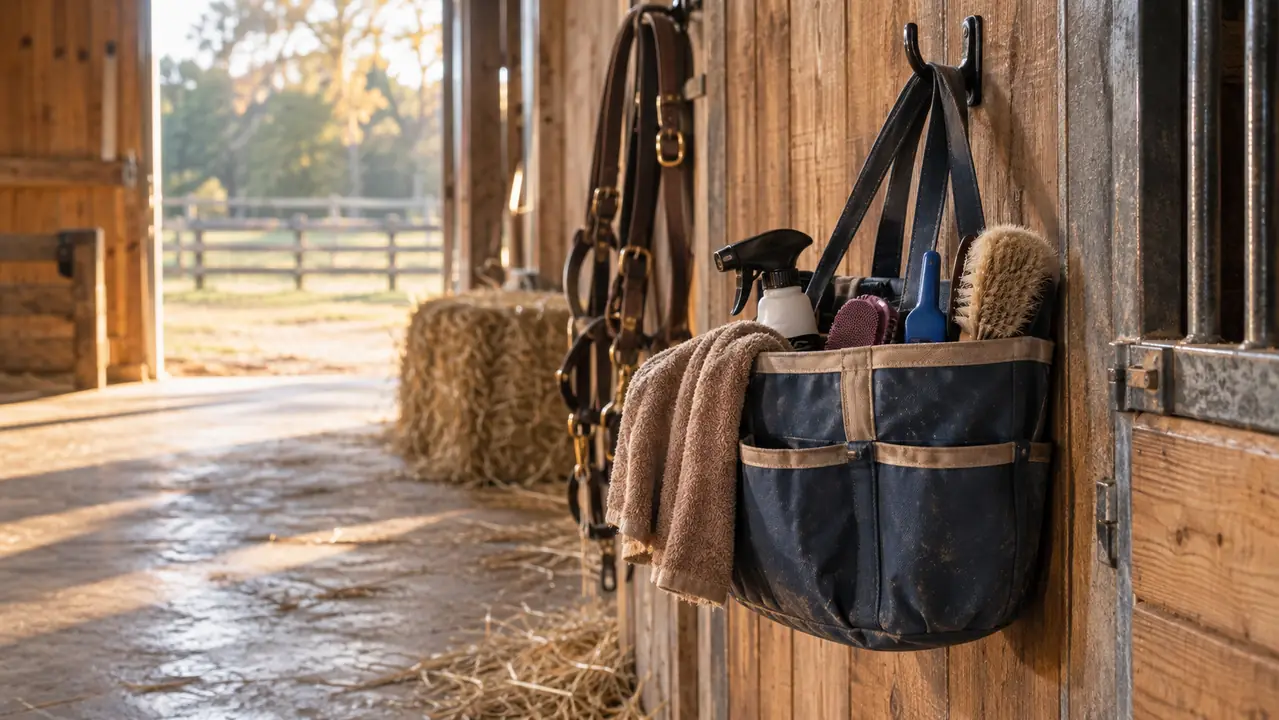
Nobody warns you that the tote bag is the part you end up caring about. I bought the Weaver Equine 7-piece grooming kit in early June 2026 because I was tired of rooting through a five-gallon bucket for a brush that still had bristles on it. Five months later the tote hangs on a hook just inside my barn door and my hand goes into it three or four times a day, sometimes more. So this is the honest version, the one that does not open with a photograph of a gleaming horse and a list of things the manufacturer wishes were true. It opens with a bucket.
My horse is Ranger, a 14-year-old sorrel Quarter Horse gelding, 15.1 hands, about 1,050 pounds, and the only horse I own. He is calm on the trail and herd-sour leaving the barn, he gets girthy if you pull the cinch too fast, and he sweats hard in an Arkansas summer. Grooming is the part of the day we both tolerate well, which makes it a fair place to be particular. Gear you touch twice a day either earns its hook or it does not. Five months is long enough to know which one this kit is, so I would rather give you the awkward parts first and the good parts after.
The Quick Verdict
A working kit, not a show kit. The tote bag and the two palm-held brushes carry the whole thing, the comb is mostly along for the ride, and the named pieces stop one brush short of a full grooming setup.
Amazon Check Today's Price →Read the piece list before the photographs sell you
The listing names every piece in the bag, which is more than most grooming kits bother to do. Read that list against the brushes already hanging in your barn and you will know in thirty seconds whether this fills a gap or duplicates one.
Amazon Check Today's Price on Amazon →What Nobody Tells You About the Piece Count
The listing calls it a seven-piece kit and then names the comb, the hoof pick, the mane and tail brush, the palm-held curry comb, the palm-held face brush, and the tote bag. Count those and you land on six. That is the sort of arithmetic that fills a review page with one-star complaints from people who counted before they ever picked up a brush, and I understand the irritation.
Let me tell you what the first morning actually looked like, because that is where the piece count stopped mattering to me. I carried the tote out to the hitching post, set it on the tailgate of the pickup, and opened it up. The comb, the hoof pick, the mane and tail brush, and the two palm-held brushes. The first thing I reached for was the hoof pick, because Ranger was due for his feet and because I wanted to see whether it would stand up to a real job on the first day. It did, and it has every day since. The second thing I found out was that the main compartment is deep enough for the pieces to stand upright instead of lying in a heap, and that sounds like nothing in the description until you have spent two years with a bag where everything lies flat and every grooming session starts with a dig.
Here is my plain answer. In five months I have never reached into that bag and come up empty for a job I needed done. The five tools that are named each do real work on a real horse. If you are buying this to complete a checklist, the missing piece will bother you every time you look at the tote. If you are buying it to replace a bucket of worn-out brushes the way I was, you will not notice, and I did not.
The second thing nobody says out loud is that the bag is not a freebie thrown in to make the number bigger. It is the reason to buy the kit at all. It has six outer pockets, webbing handles, and a main compartment deep enough that the pieces stand upright instead of lying in a heap. The listing puts the dimensions at 11 inches long, 10 inches wide and 7 inches high, and the whole thing weighs a little under three pounds loaded. That is light enough to hang on a hook on a barn wall without pulling the screw loose, which my old bucket of brushes could not do because a bucket does not hang at all.
How It Has Held Up Over Five Months
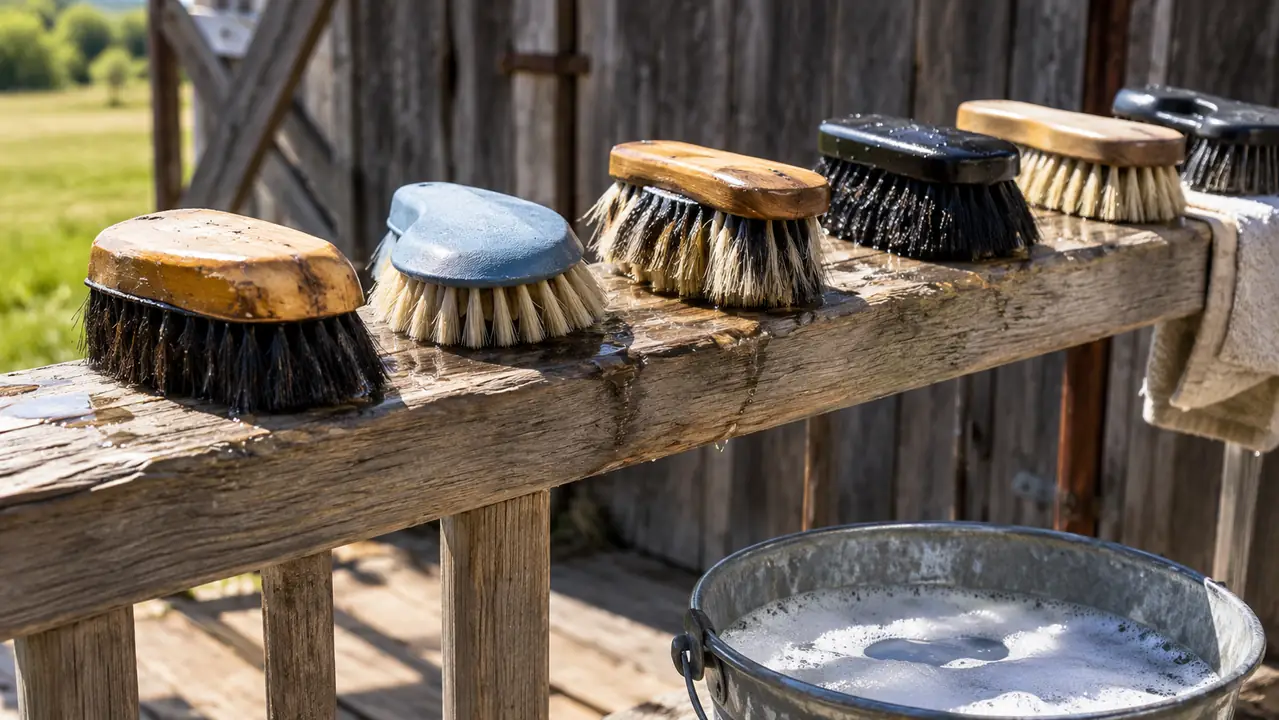
Once a month I fill a bucket with warm soapy water, drop the brushes in, work the bristles through with my fingers, rinse them, and set them bristles-down on the porch rail in the sun to dry. That is five washings since June, plus a lot of shaking out and a few hose-downs after muddy trail rides. Not one bristle block has shed into the water. I cannot say the same for the old brushes I retired, three of which were balding when they came out of the bucket for the last time.
Take the second week of October, which is when I stopped wondering about the plastic backs at all. We had rain for three days straight and the gate out to the pasture turned into a wallow. Ranger came in with mud to his knees and mud dried into his tail like rope. I hosed him down, then worked the mane and tail brush through that tail one section at a time while he ate hay, and the Weaver Equine brush came out the other side with every bristle still set in the block. My previous tail brush lost a whole row on a tail like that and I threw it away that same evening.
The plastic bodies and the nylon handles have both stayed tight where the bristle block meets the back of the brush. Nothing has cracked, nothing has wobbled, nothing has come apart in my hand. The webbing handles on the tote have carried a full load from the barn to the pasture gate and back more times than I can count, and the seams on the outer pockets are still holding. The pocket I keep the hoof pick in has stretched a little. I expected that, because it is the piece I pull out fastest and I am not gentle about it.
The bristles themselves are horse hair, and they have softened rather than splayed. That matters more than it sounds. A stiff new brush on a thin-skinned horse will make him flinch, and Ranger flinches honestly. Five months in, the palm-held curry and the mane and tail brush work easier against him than they did in June, and that is the brush breaking in, not wearing out. The mane and tail brush is also the piece that handles his tail in November mud, which is a completely different job than his tail in June.
The Two Pieces I Would Buy Again on Their Own
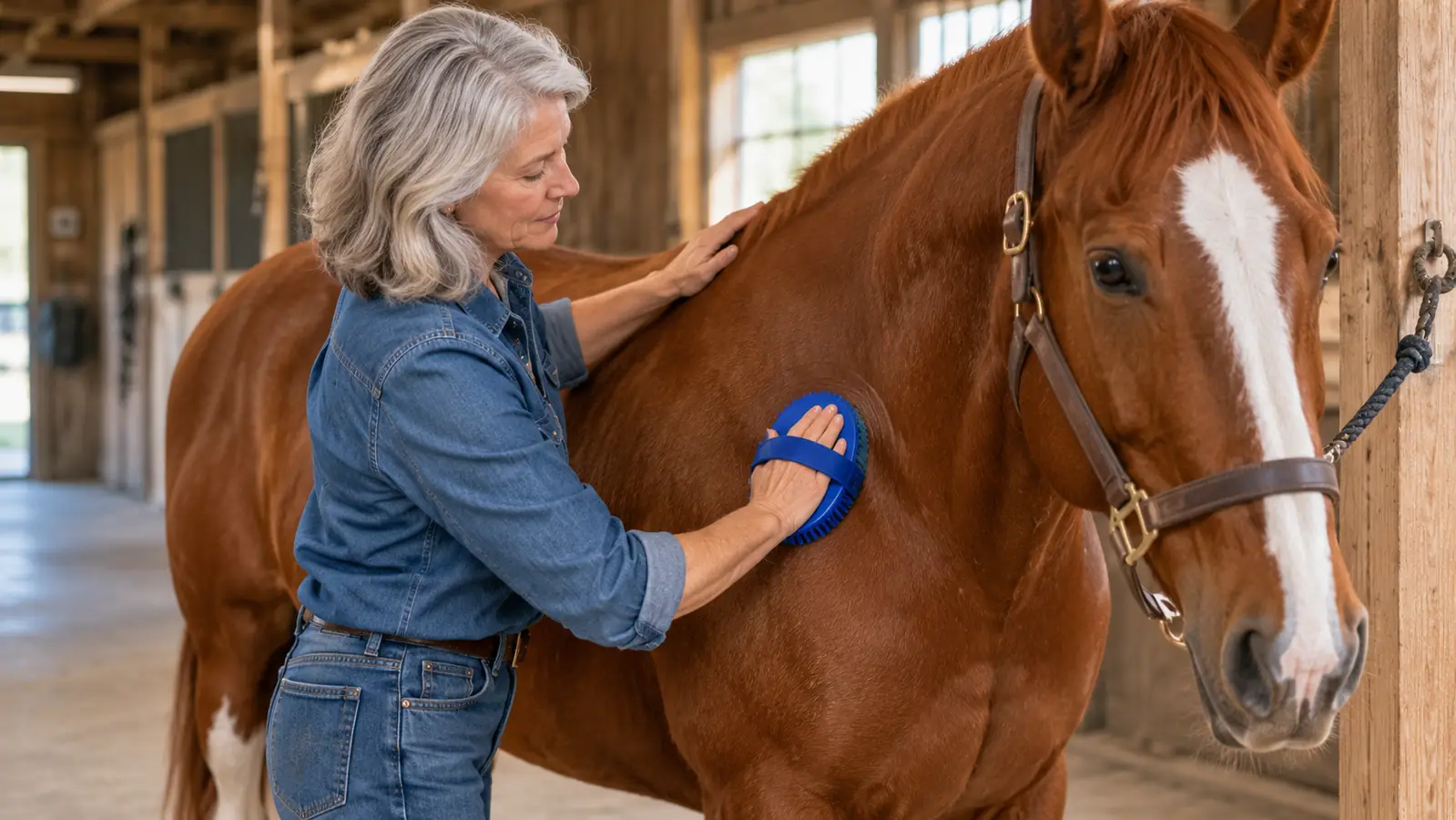
The palm-held curry comb and the palm-held face brush are the reason this kit works for me, and if I could buy them loose I would. Palm-held means the strap goes over the back of your hand, so the brush stays where you put it when Ranger shifts his weight or swings his head at a fly. My old curry comb was a disc I had to keep re-gripping, and I dropped it in the dirt more times than I will admit here. This one I can work in circles on his shoulder while the lead rope stays in the same hand, which matters when you are grooming a horse tied to a post with nobody else around.
The curry comb does something I did not expect on a hot day, too. Ranger sweats heavy in an Arkansas summer, and a curry is what lifts the dried salt and the sweat line off before a brush ever touches him. Through July and August I used that palm-held curry almost every evening, sometimes twice when he came in wet, and my wrist never once tired of it because the strap over the back of the hand is doing the work of holding on. That is the whole difference between a tool you reach for and a tool you avoid, and it took about a week to feel it.
The face brush is the piece Ranger votes for, and he does not usually vote for anything. He is not a horse who enjoys having his face handled. He will stand for the palm-held face brush because the pressure is light and my hand is right against his cheek, so he can feel where I am and what I am about to do. That is not a feature the listing advertises. It is what five months of using it on one horse taught me, and it is the sort of thing you only find out by trying.
What I did not expect is how much the tote changes the order of a grooming session. Everything has a pocket, so I curry, then brush, then pick feet, then do the face last, without setting anything down in the dirt or patting around for it. Before, I worked out of a bucket and half the session was searching. That is a small thing that adds up over a hundred and some groomings.
Five months, five washings, one stretched pocket, and not a single bristle block shed into the bucket. The bag has outlasted my expectations of the bag.
Where It Falls Short
Three honest complaints, starting with the one that will matter most to somebody buying their first kit. The named pieces do not include a full-size body brush. The palm-held curry does the loosening, the palm-held face brush does the finish, and the mane and tail brush handles the hair, but the long sweeping strokes that lift dust off a sweaty horse in July still come from the old body brush I kept in the outside pocket. If you are starting from nothing, plan on buying one more brush.
Second, the plastic-backed pieces feel light in the hand. Light is not the same as flimsy, and nothing has cracked in five months, but if you are used to a wooden-backed brush with some heft to it, the first week will feel like grooming with a toy. I noticed for about a week and then I stopped noticing, which is usually how these things go.
Third, the six outer pockets are snug. Bare-handed, on a warm day, they are fine. In a winter glove, the hoof pick pocket takes a second longer than it should, and in February a second is cold. The hoof pick also ends up loose in the main compartment if you do not claim a pocket for it on the first morning, and then you are back to fishing around, which is the exact thing the tote was supposed to end.
One more thing worth saying plainly: this is a grooming kit, not a bathing kit and not a first aid kit. There is no sweat scraper and no sponge in the bag, and the listing does not pretend there is. If I want to wash Ranger I am still carrying a bucket and a hose down to the hitching post. If he opens a scrape on a branch, I am still walking back to the tack room for the box. I knew that when I bought it, and I would rather the money went into five tools that work than into a scraper I already own two of.
What I Liked
- Six outer pockets and a deep main compartment mean every piece has a home and stands upright
- The palm-held curry comb and palm-held face brush stay on the hand, and my horse stands for both
- Horse hair bristles have not shed or splayed after five monthly washings
- Nylon tote and webbing handles have carried a full load with no seam failure
- Just under three pounds loaded, so it hangs on a barn wall hook and stays there
Where It Falls Short
- The named pieces stop one short of a full setup, with no full-size body brush in the bag
- The comb is the piece I reach for least, especially on a muddy November tail
- Plastic backs feel light compared to a wooden-backed brush
- Outer pockets are tight for a gloved hand
- The hoof pick ends up loose in the main compartment unless you claim a pocket for it
What I Would Change If I Could
If I were designing this kit for a rider like me, I would swap the comb for a full-size body brush and not think twice about it. The comb earns its pocket on a mane. It does very little for a muddy tail in November, and the mane and tail brush is already doing that work. That single swap would turn a good kit into a complete one, and it would settle the most common complaint on the listing in one move.
I would also open the outer pockets by a quarter inch and add a small loop for the hoof pick, so a gloved hand on a cold morning is not a contest. And I would print the piece list somewhere on the bag itself, in letters big enough to read in a barn aisle, so nobody has to count to six and wonder what happened to the seventh thing. Small changes. None of them are reasons to walk away from the kit as it stands.
Is It Worth It
That depends entirely on what is hanging in your barn right now. I came to this kit from a five-gallon bucket of mismatched brushes, several of them worn nearly flat, none of them with a strap that stayed on my hand. Against that, it is not a close call. I use it before every ride and most days in between, which works out to well over a hundred groomings since June, and every one of those was faster and less aggravating than the bucket ever was.
If you are coming from a set you already like, the math is different. You would be buying a tote bag with some brushes attached, and you should decide whether the tote is worth it to you on its own. For me it is, and the reason is simple: Weaver Equine built the bag like the bag was the product and the brushes came along with it. That is the opposite of how most kits are put together, and it is why mine is still on the hook.
Who This Is For
This kit suits a rider with one horse and a daily grooming habit. Somebody who grooms before every ride and most days in between, and wants the whole business to live in one place on the barn wall within reach of the crossties. It suits a trail rider who trailers out once a month and would rather grab one handle than pack four loose brushes into a duffel. It also suits somebody rebuilding a grooming setup from scratch who would prefer to buy a kit with a bag than guess at six separate purchases and end up with two of the same thing.
Who Should Skip It
Skip it if you already own brushes you like and only need one replacement. Skip it if a full-size body brush in the box is a dealbreaker, because it is not in the named pieces and you will be buying one anyway. Skip it if a gloved hand in a snug pocket will irritate you every single morning, because it will. And skip it if you want a heavy wooden-backed brush in your hand, because this is not that. None of those are knocks on the kit. They are just reasons it might not be your kit.
If your brushes still live in a bucket, this ends the search
Five months in, the tote is on the hook, the pieces are in their pockets, and I have stopped thinking about grooming gear entirely. That is the highest thing I can say about any tool I use every day.
Amazon Check Today's Price on Amazon →