
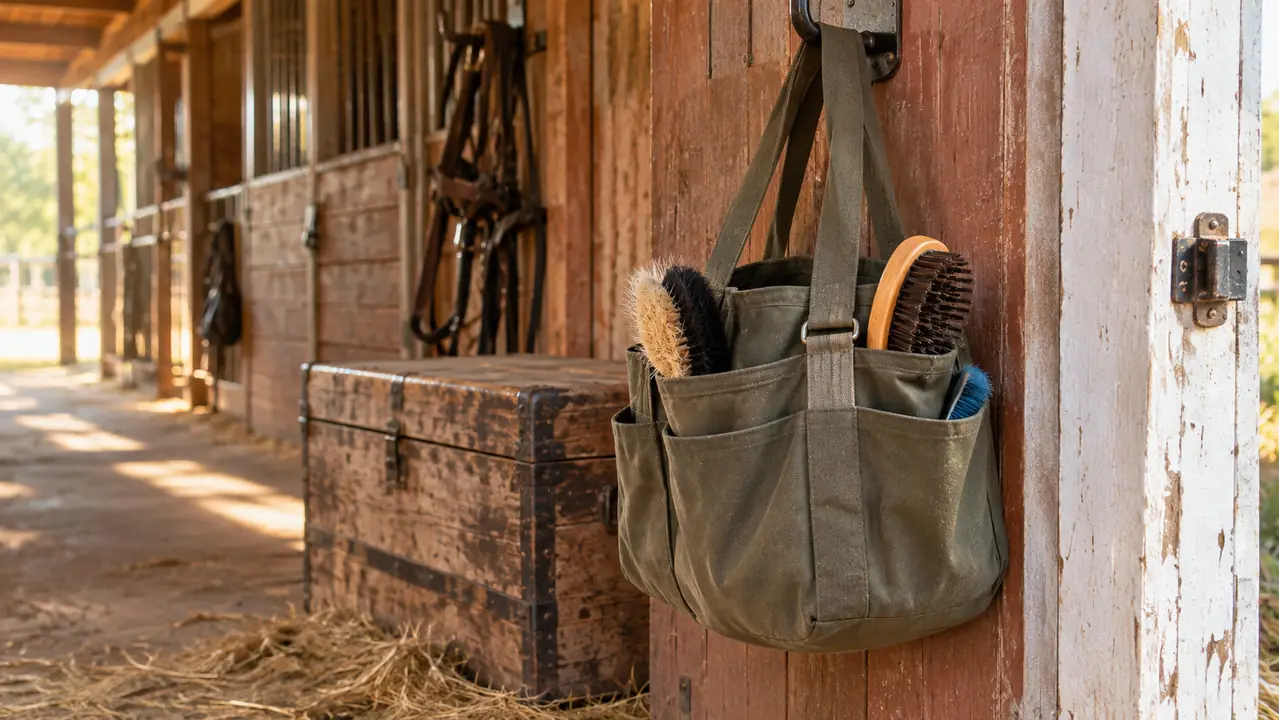
Two grooming kits keep coming up when you search for horse brushes on Amazon: the Weaver Equine 7-piece kit with the tote bag, and the TERPUP 13-piece kit that offers nearly twice as many pieces. Riders ask me which one belongs in the tack room, and my answer is not the one with the bigger count. I have used the Weaver Equine kit on Ranger, my 14-year-old Quarter Horse gelding, since the first week of June 2026. That is five months of grooming before nearly every ride, plus most mornings in between. I have never had the TERPUP kit in my barn and I am not going to pretend otherwise. What I can do is tell you every piece that came in my tote, what the TERPUP listing actually promises, and which of those differences you will feel at six in the morning with a horse that wants his breakfast.
Short answer first. If you own one horse and you groom him most days, the Weaver Equine kit is the one I would buy again, because everything in the bag gets used and nothing in it needs explaining. If your shelf is empty or you keep more than one horse, the TERPUP kit's thirteen pieces cover more of a horse, and that counts when you are starting from a bare wall. What follows is the detail behind that split: the two brushes I reach for every single day, the piece I ended up adding on my own, and the honest reason the bigger kit still has a case.
| Weaver Equine 7-Piece | TERPUP 13-Piece | |
|---|---|---|
| Pieces in the kit | Seven, counting the tote bag | Thirteen |
| Named pieces I could confirm | Comb, hoof pick, mane and tail brush, palm-held curry comb, palm-held face brush, tote | The title says thirteen; the listing I read does not itemize all thirteen |
| Storage | Nylon tote with six outer pockets and webbing handles | Not described in the same detail on the listing I read |
| Warranty | Listed as Always Guaranteed | No warranty language I could find |
| Track record | 4.7 stars from about 3,600 ratings | I have not used it and cannot vouch for it |
| Best for | One horse, daily grooming, a bag that hangs on a hook | An empty shelf, or several horses |
| What you give up | Fewer pieces than the TERPUP kit | I could not confirm the brush shapes or the bag layout |
Where the Weaver Equine Kit Wins
The tote is the part I did not expect to care about. It is a nylon bag with six outer pockets, and those pockets are why my brushes are not living in a bucket anymore. Curry in the left front pocket, face brush in the right, mane and tail brush in the one I can reach without looking. The bag hangs on a hook just inside the barn door, so the whole kit comes down in one hand and goes back up the same way. It measures about nine and a half inches square and six and a half deep, and the listing puts the packed kit at a little over two and a half pounds. That matters more than it sounds when the horse is at the far end of a four-acre pasture and you are sixty-one years old and carrying a halter as well. Before June my setup was a five-gallon bucket of mismatched brushes, half of them worn flat and none of them where I wanted them. I have not gone looking for that bucket since.
I timed it once out of curiosity. From the moment I lift the tote off the hook to the moment I set it back, a full groom on Ranger runs about twenty-five minutes, and I spend maybe ten seconds of that hunting for a brush. With the bucket it was closer to forty minutes and a fair amount of muttering. On a November morning when the light is still gray and the coffee is going cold on the fence post, ten seconds here and ten seconds there is the whole difference between getting the ride in before the wind picks up and not getting it in at all. The bag also keeps the brushes off the ground, which matters more than you would think in a barn aisle where the muck fork lives.
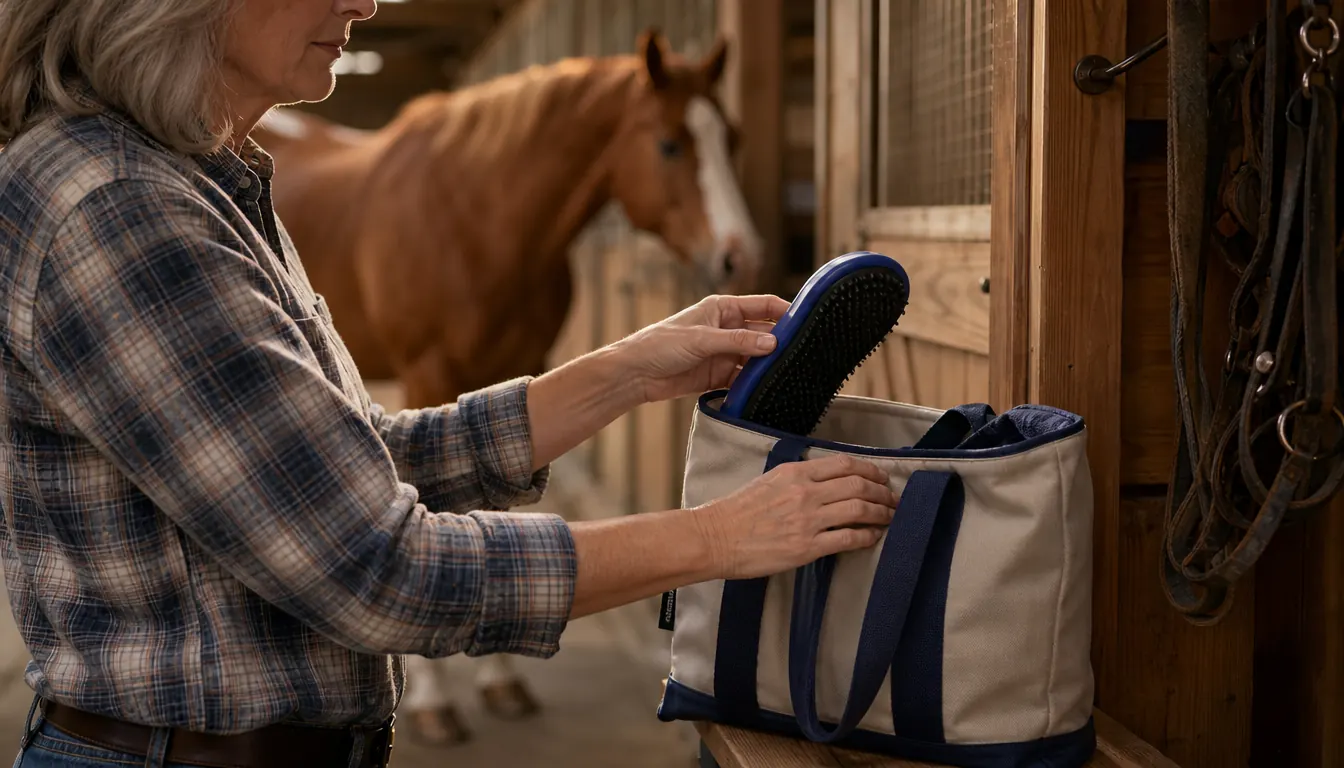
The two brushes I use most are the palm-held ones, and they are the reason I stopped buying handled brushes for close work. A palm-held curry comb rides in your hand with a strap across the back instead of a handle, so you curry with your whole hand and not just your wrist. That sounds like a small thing until you have curried a shedding Quarter Horse for twenty minutes in July and your fingers have quit on you. The palm-held face brush is the same idea, and it is the only brush Ranger stands still for on his face. Weaver Equine lists the kit as Always Guaranteed, which is the kind of warranty line most brands will not put in writing, and the kit holds a 4.7 star average across roughly 3,600 ratings. In five months and five washings nothing has cracked, no stitching has let go, and the webbing handles have not frayed.
Where the TERPUP 13-Piece Kit Wins
Thirteen against seven is not a marketing trick, and I am not going to wave it away. If your shelf is genuinely empty, thirteen pieces means you are far less likely to be caught short in the middle of a groom with a wet horse and one brush. Extra brushes mean a spare while one dries after a washing, and they mean you can keep one for legs and one for the body instead of doubling up. I spent my first couple of years with a single stiff brush and used it for everything, including the places on a horse where a stiff brush does not belong. A kit that hands you more options on day one saves you that particular mistake, and it saves you the feed store trip you would otherwise make in a hurry.
I know what that looks like because I lived it the wrong way round for years. When I bought Ranger in 2020 I had one stiff brush, a plastic comb with half its teeth gone, and a hoof pick I kept in my coat pocket, and I used that stiff brush on his face until he started throwing his head every time I reached for it. A horse does not forget that. I spent the better part of a summer earning back the right to touch his ears and his jaw without him stepping away from me. A kit that puts a face brush and a body brush in your hands on the same day, with nothing to work out, spares a new owner that whole argument. That is the real value of a bigger piece count, and it is not a small thing.
A larger kit also makes sense if you keep more than one horse, or if you board, where brushes get borrowed and do not always come back to the right hook. A friend of mine keeps two geldings and grooms both before every ride, and her brushes take twice the dirt mine do. For a barn like hers, thirteen pieces is not excess, it is working stock. I will say plainly that I cannot tell you how the TERPUP brushes feel in the hand, what its bag is made of, or how its bristles hold up after a season, because I have never had one in my tack room and I would be guessing. What I can tell you is that the piece count is the honest argument in its favor, and for a lot of riders it will be the deciding one.
Five Months in an Arkansas Barn
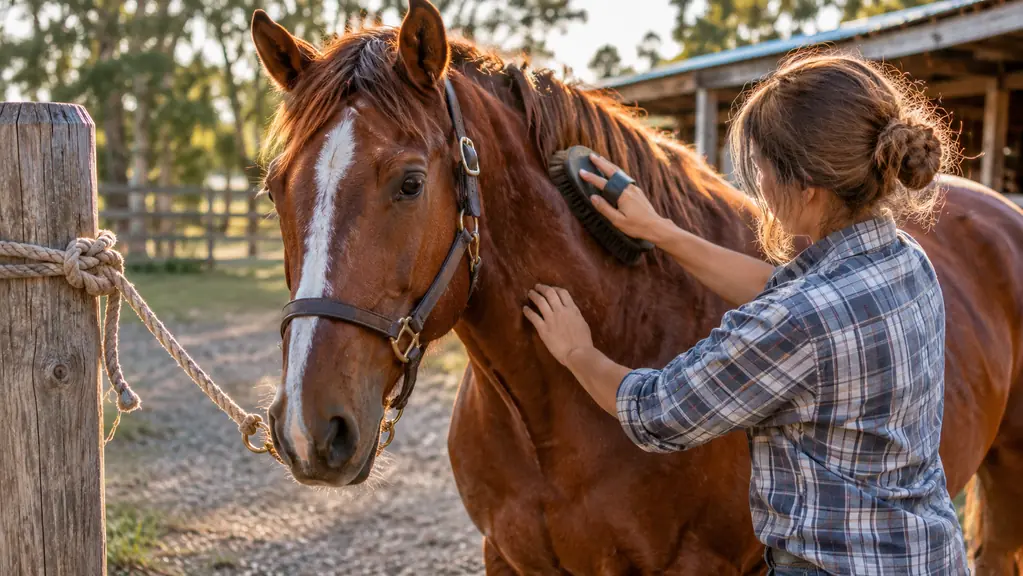
Most mornings it goes like this. I am out at the barn a little after six with a bucket of feed, and Ranger comes in off the pasture while I muck the stall. I put the halter on, tie him to the post with a quick-release knot, and groom him while he eats, then turn him back out. Weekends I do the whole thing again before we load up, and that groom is the longer one, because I want his back clean where the pad sits and no mud under the cinch. The halter and the tote hang within arm's reach of each other at the end of the aisle, so I am never setting anything down in the mud or walking back to the tack room with dirty hands.
Here is what the grooming itself looks like. The tote comes off the hook, and I curry Ranger's neck, shoulders and the hollows behind his front legs with the palm-held curry, working in small circles with the lie of the hair. He gets girthy when the cinch is pulled tight too fast, so I groom him loose and slow before I ever set the saddle on. The mane and tail brush goes through his tail a few inches at a time, starting at the ends and working up, because pulling a knot straight through is how you end up with a horse that will not stand for his tail to be touched. The face brush handles the dried mud on his jaw and around that blaze. The hoof pick is the last thing I touch, and our farrier told me years ago to pick from heel to toe and never to dig at the frog, so that is how I do it.
The kit washes up in a bucket of warm soapy water about once a month. I rinse the bristles, shake them out, and set them bristles down in the sun on the porch rail to dry, which keeps water out of the wood and the glue. Nothing has come loose. The tote gets wiped out with a rag and hung back on its hook. The only wear I can point to is the nylon looking dustier than it did in June, and I only notice that because I am hunting for something to complain about.
Seven pieces, one hand, one hook by the door, and I have not gone looking for that bucket since June.
For the hot months I keep a sweat scraper and a wide body brush of my own on the same hook. The palm-held brushes are detail tools, and a horse that has been working in Arkansas humidity in July needs the wide brush first and the detail work second. Ranger sweats hard under the saddle and down the neck, and a scraper is not optional here. That is not a knock on the kit. It is the shape of the job. Every kit I have ever seen is a starting point that a rider adds to over a season.
The kit that hangs by my barn door
Seven pieces I actually use, a tote with six outer pockets, and nothing in the bag I have to move out of the way to reach the brush I want.
Amazon Check Today's Price on Amazon →Who Should Buy Which
Buy the Weaver Equine kit if you have one horse and you groom him most days. It suits a rider who wants the brushes to live in one bag that comes down off a hook and goes back up, who does not want to sort through thirteen pieces to find the curry, and who would rather add a wide brush and a scraper later than buy them twice. It also suits hands that do not grip a handled brush the way they used to. The palm-held brushes ask less of your fingers, and at sixty-one I notice that more than I would have at forty.
One more thing on that. If you have arthritis in your hands, or you have ever had a brush handle roll out of your grip into the aisle while the horse stood there wondering what you were doing, the palm-held pieces are worth the whole kit on their own. I sewed a little in my mail-carrying days and I still mend my own tack, and I know what a handle does to a tired hand by the end of a long day. Currying with a flat palm is a different motion, closer to wiping down a counter than to gripping a tool. It is why I reach for those two brushes first, and why I would not go back to handled brushes for close work.
Buy the TERPUP 13-piece kit if you are starting from an empty shelf, if you keep more than one horse, or if you want the widest spread of brushes in a single order from a standing start. On paper it covers more of a horse, and a rider still learning which brush goes where will not run out of options halfway through a groom. Either way, hang the bag where you can reach it dry, wash the brushes before the first use, and set them bristles down to dry after every washing. A brush that stays wet at the base is a brush you will replace early.
If you want the kit I would buy again
Five months on Ranger, five washings, nothing cracked and no stitching gone. Seven pieces, one tote, one hook by the door.
Amazon See the Weaver Equine Kit on Amazon →