
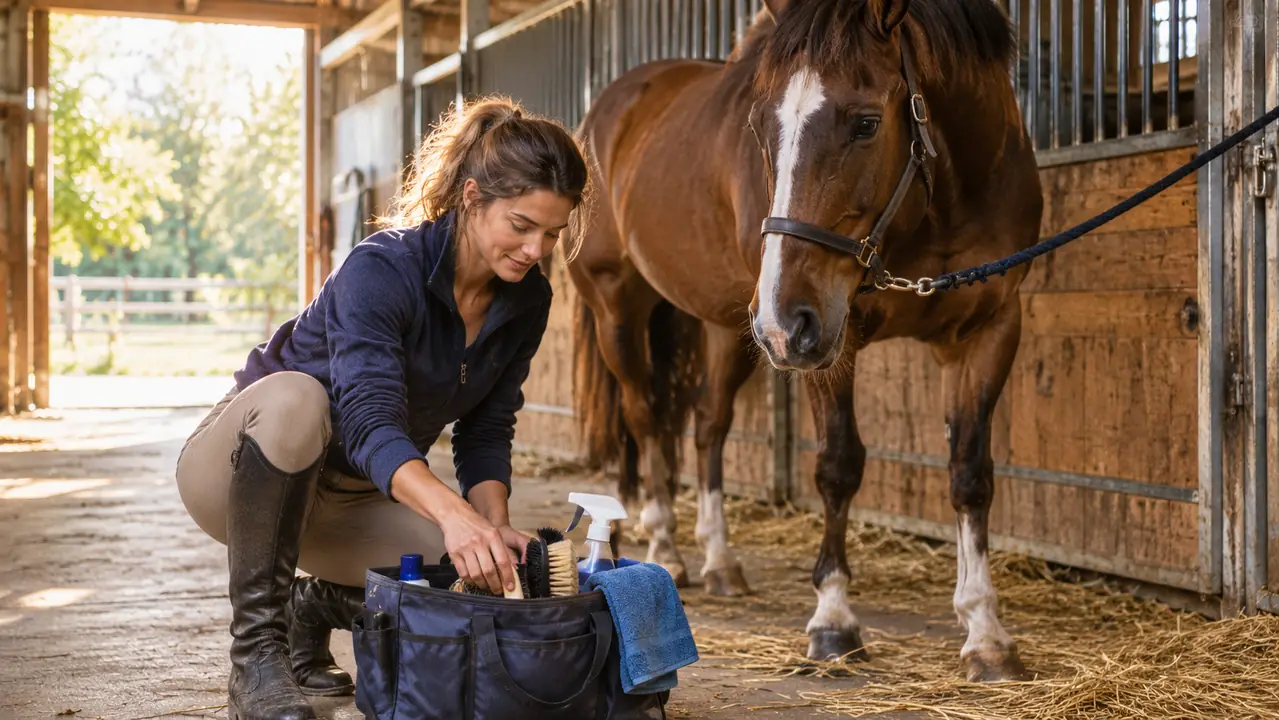
The bucket was the problem. Not the grooming. I have groomed a horse nearly every day since I was nine years old and I do not mind the work. The problem was the five-gallon plastic bucket at the end of the barn aisle with nine brushes in it, four of them worn past the bristles down to bare backing, one with a cracked handle, and a hoof pick that went missing sometime in 2025 and never came back. Every time I tacked up Ranger I stood there pawing through that bucket looking for the one brush with enough left in it to lift the dirt off a sweaty shoulder. Early in June 2026 I ordered the Weaver Equine 7-Piece Grooming Kit with the tote bag, and the bucket went out to the burn pile that same week.
Ranger is a 14-year-old sorrel Quarter Horse gelding, 15.1 hands, about 1,050 pounds, and he sweats like a hog in an Arkansas August. I ride him Western, trail only, three or four times a week when the weather allows, an hour and a half at a stretch on the Forest Service trails and the gravel roads out from our place near Harrison. That works out to something close to ninety times I have had my hands on him with these brushes since the kit came, plus most days in between when he comes in muddy and I cannot stand to leave him that way. Five months is long enough to know what a thing is made of, so here is the whole of it.
The Quick Verdict
A tidy kit that ended years of digging through a bucket, and after five months of daily use nothing in it has cracked, frayed or quit. The tote is the reason to buy it. The palm-held face brush is the reason I keep reaching for it.
Amazon Check Today's Price →Five months in, the tote is the part I would buy again
Seven pieces in a nylon tote with six outer pockets, hanging on a hook where I can see all of it at once. It replaced a bucket I had been digging through for years.
Amazon Check Today's Price on Amazon →How I've Used It
The tote hangs on a hook just inside the barn door, and that sounds like nothing until you have lived with the alternative. The old bucket sat on the floor at the end of the aisle, and whatever I wanted was always at the bottom of it. Now I lift the tote off the hook, set it down beside the post where I tie Ranger, and everything faces me. Six pockets around the outside, the tools standing up in them, nothing buried, nothing rolling under a stall mat. I tie him with a quick-release knot, work the near side first, then walk around and do the off side, and the tote comes with me.
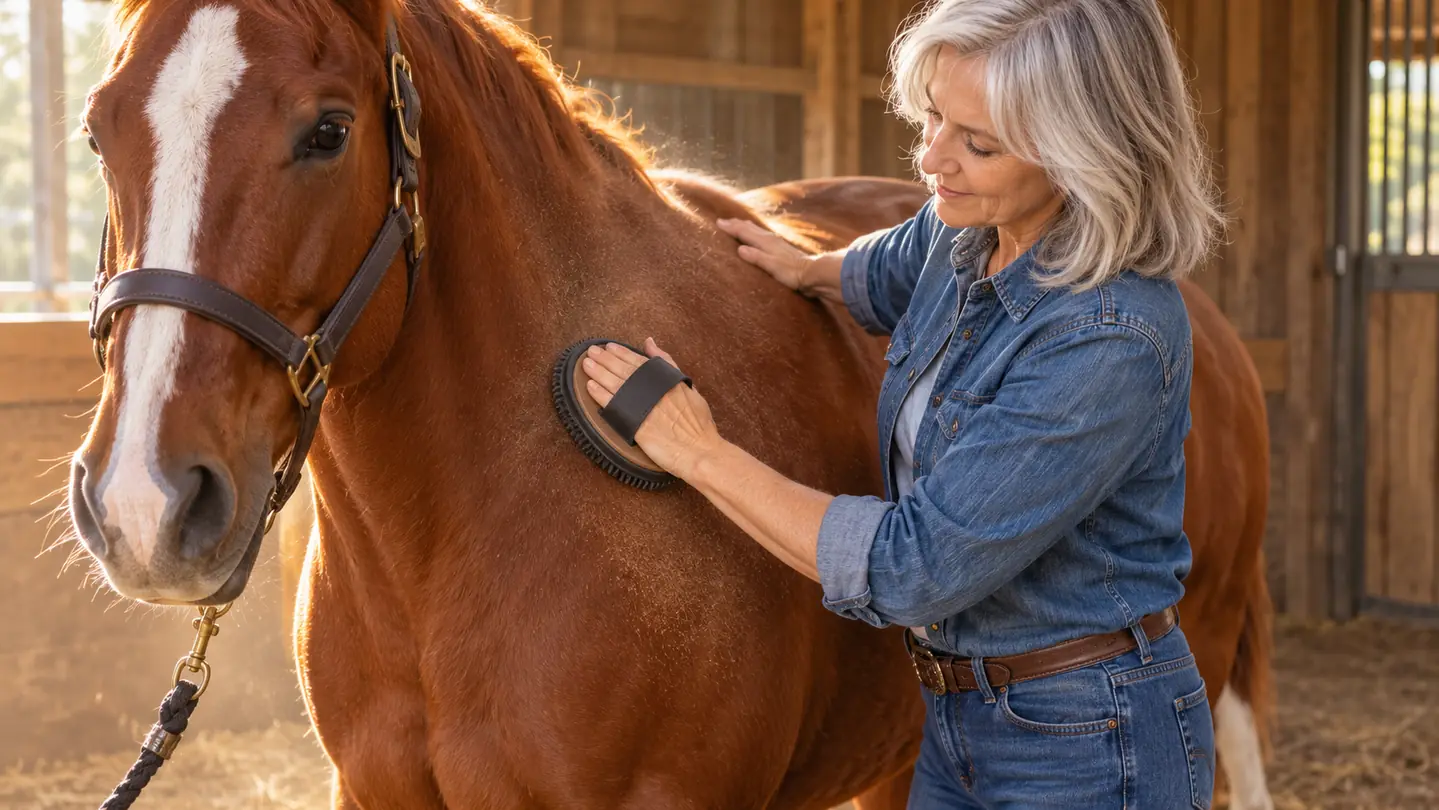
My order has not changed in forty years. Curry first, in circles, working the dried sweat and dust up out of the coat. Then the face brush for the loose stuff and for his face, careful around the eyes and ears, and gentle over the white blaze. Mane and tail brush next, and I work the tail from the bottom up so I am not pulling hair out of the dock. Hoof pick last, all four feet, before the saddle ever comes off the fence. That is twelve minutes on a clean horse and twenty-five on a muddy one, and the kit has done all of it since June.
The curry and the face brush are both palm-held, which means your hand lies flat over the back of the brush instead of wrapping around a handle. I did not expect to like that. I like it. You can feel where the brush is on the horse through your own palm, and on a gelding who pins his ears when you get careless around the flank, that is worth something. I also use the palm curry on his left hind, the one with the white sock, because it comes in muddy and a palm-held brush lets me work by feel instead of by looking.
One Saturday in August I got home late from a ride and Ranger had rolled in the pasture mud hole and dried that way, mud caked from his shoulder down over his barrel and packed into the left hind down to the hoof. I tied him, lifted the tote off the hook, and worked the palm curry in small circles, letting the mud break up rather than trying to scrape it off in one pass. Twenty-five minutes and a full brush-out later he was clean, and I had not had to walk back to the barn once for anything I had left behind. With the old bucket that would have been three trips, because I never once had the right brush in my hand the first time.
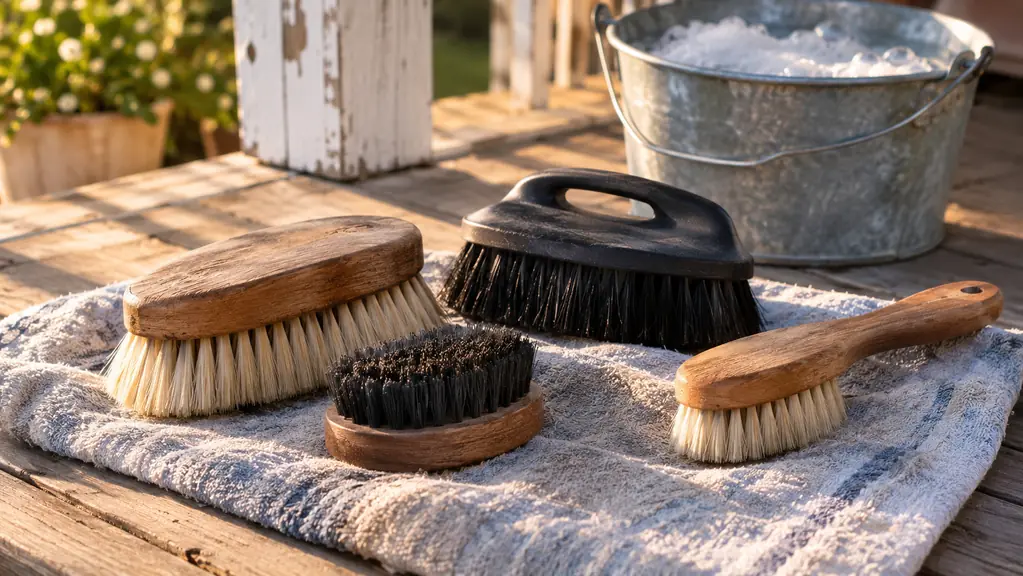
About once a month I fill a bucket with warm soapy water, work the soap through the bristles, rinse them well, and set them bristles-down on a towel on the porch in the sun to dry. The nylon handles and the plastic backs have not cared a bit. I rinse the tote out with a damp rag, hang it back on its hook, and that is the whole maintenance routine. Nothing has been oiled, glued, taped or repaired.
What Is Actually in the Tote
The Weaver Equine listing calls it a seven-piece kit. The pieces I use are the comb, the hoof pick, the mane and tail brush, the palm-held curry comb and the palm-held face brush, all carried in the tote. The tote itself is nylon, oblong, about eleven inches long by ten wide by seven tall, and the whole loaded kit weighs a little over two and a half pounds. That last number matters more than it sounds. I carry it out to the pasture gate with a halter over my other arm, and my knees are sixty-one years old and not getting any better.
I load mine the same way every single time, and that is half of why it works. Hoof pick in the front right pocket, so my hand finds it without my eyes getting involved. Curry on the left. Face brush next to it. Mane and tail brush in the long back pocket, bristles up. Comb in whichever pocket is empty, which is usually the one nearest the handle. I put a nail in the door frame at chest height and the tote hangs from its webbing handles there, so I am not bending for it at the start of every ride. At my age that is not a small thing, and I did not think to do it until the second week.
The hoof pick gets the most work of anything in the kit and it has held its point. The curry is second, used twice a day in summer. The face brush is third and would be the first thing I replaced if I lost it. The comb is the piece I reach for least, mostly for the forelock and for breaking dried mud out of the mane before the brush goes in. None of that is a knock on the comb. It is just that a horse with a short mane does not need much combing.
The bristles are horse hair, the handles are nylon, and the bodies of the brushes are plastic. The tote has webbing handles that have not cut into my hand even loaded and swinging. The listing gives the warranty as always guaranteed, which is the kind of promise that means whatever the company decides it means. I have not had to test it and I would rather not.
Five Months of Sweat, Mud and Arkansas Dust
June through October is the real test here. Ranger sweats through a ride and then dries stiff, and by evening there is a crust of salt and dirt across his shoulder that a soft brush will not touch. That is the curry's job, and it does it. I have not had to go at him with anything harsher, and on the ordinary days I have not had to curry him twice.
July was the worst of it. We had a stretch of days over a hundred degrees and Ranger was sweat-soaked by nine in the morning just standing in the shade. I groomed him twice on those days, once at the gate to get the night's dried sweat off and once again before the ride, and the curry got a workout it will not see again until next summer. What surprised me is that the brush never clogged solid. Hair and dust come out of horse hair bristles with a couple of taps against the fence post. The old flat-backed brush I threw out in June had to be picked clean with a hoof pick and still never came clean.
Shedding season was a different story. In March and April he looks like something died in the pasture and left a horse behind, and horse hair bristles are too soft to get a winter coat out. I kept one old stiff brush in the tack room for that and I still keep it. That is not a fault in the kit so much as a job the kit never claimed. Anyone who tells you a soft brush strips a spring coat is telling you a story.
The hoof pick has been through four feet, twice a week, for five months, in wet Ozark mud and packed gravel. Our farrier sees Ranger every six to seven weeks and Ranger is shod in front only. The pick has held its point better than the two before it, one of which bent at the tip and one of which I lost somewhere between the barn and the trailer.
On the longer monthly rides I trailer Ranger in the bumper-pull, and the tote rides along in the tack compartment instead of a bucket rolling around and dumping brushes under the saddle pad. It got rained on once through a leaky spot in the trailer roof, hung up wet overnight, and was no worse for it in the morning.
The honest summary after five months is that nothing has failed. No bristle block has come loose, no handle has split, no seam on the tote has opened. The only wear I can point to is that the webbing handles have softened and the outside of the bag has taken on the general color of our driveway.
Five months, close to ninety grooming sessions, and nothing in the kit has failed. The worst I can say about it is that the outside of the tote is dusty.
The Parts I Would Change
The tote fabric holds dust. It is nylon and dust is what a barn is made of, so this is less a complaint than a fact of the place, but the bag does need a wipe down every couple of weeks or it starts to look worse than the brushes inside it. A damp rag takes care of it in under a minute.
Before the tote I tried a canvas tool bag from the hardware store, thinking I could just carry the old brushes in it and be done. It had no outside pockets, so everything settled into one pile at the bottom and I was still digging, only in a smaller bucket. The canvas soaked up water the first time it sat on the wet aisle floor after a rain and smelled like a barn boot for a week. I gave it to Earl for his truck tools. The six outer pockets on the Weaver tote are the whole difference between a bag that holds brushes and a bag that keeps them where you can find them, and until I had used both I did not know that was the point.
I would happily trade the comb for one stiffer brush for mud season and spring shedding, and I would not miss the comb at all. That is my preference for my horse, not a defect in the kit. If you already own a good stiff brush, you will not notice the gap. I also wish the pockets were a touch deeper, because the mane and tail brush sits a little proud of the tote when I carry it by the handles at an angle.
What I Liked
- The tote with six outer pockets keeps every tool visible and off the barn floor
- Palm-held curry and face brush give you feel through your hand instead of a handle
- Hoof pick has held its point through five months of mud and gravel
- Nylon handles and plastic backs shrug off the monthly soapy wash
- The whole kit weighs a little over two and a half pounds and carries easily to the gate
- Nothing has cracked, split, frayed or come apart since June
Where It Falls Short
- Horse hair bristles are too soft for a heavy winter coat in early spring
- The comb is the piece I use least on a horse with a short mane
- The nylon tote holds dust and needs a wipe down every couple of weeks
- No stiff mud brush in the kit, so I kept one old brush for that job
Who This Is For
This kit is for the person who grooms one horse at home several times a week and wants the tools in one place and still usable next spring. It suits a small barn with a hook to hang it on, a dry lot, and a horse that comes in dirty more days than not. It suits a rider who trailers out once a month and would rather carry a bag than listen to a bucket roll around in the tack compartment.
It also suits the person who has been meaning to throw out a bucket of worn-out brushes for two years and has not gotten around to it. One order, one hook on the wall, and the whole mess is dealt with. That was my situation exactly, and it has stayed dealt with.
Who Should Skip It
If you are grooming three or four horses a day, a kit in a tote is not your answer. You want a proper grooming box and heavier brushes, and you will wear this set out inside a year. If your horse lives out in deep mud and you knock heavy dried mud off him every single day, you need a stiff brush first and this kit second.
And if you already own good brushes that fit your hand, replacing them with someone else's idea of a set will not improve your mornings. Buy the pieces you actually need instead. There is no prize for owning a full kit.
You can keep digging through the bucket, or you can hang this on a hook
Seven pieces, a nylon tote with six outer pockets, and five months of daily proof on one sweaty Quarter Horse. Mine has lived on a hook by the barn door since June and I have not reached for the bucket once.
Amazon Check Today's Price on Amazon →