
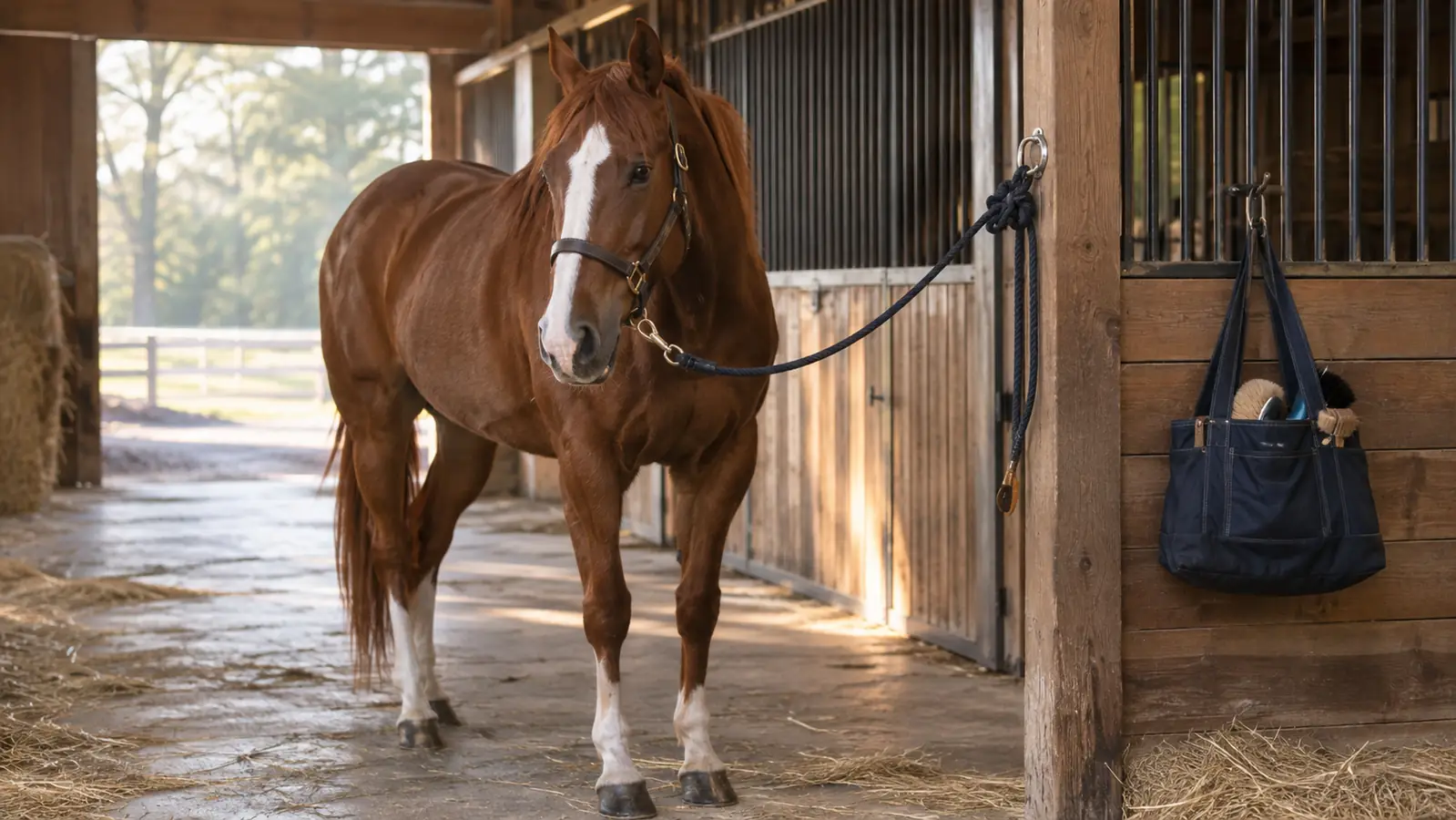
Ranger does not care what my brushes look like. He is a 14-year-old sorrel Quarter Horse gelding, 15.1 hands and about 1,050 pounds, and what he cares about is whether the curry comb is already in my hand when I walk up to him, or whether I am on one knee digging through a five-gallon bucket for it. For years it was the bucket. Mismatched brushes, half of them worn nearly flat, and a hoof pick that went missing twice a summer. In early June 2026 I bought the Weaver Equine 7-piece grooming kit with tote bag. The difference was not the bristles. It was that everything finally had a place to live, and the whole thing hung on a hook by the barn door.
Five months of use is long enough to know whether a kit earns its shelf space. I ride three or four times a week in good weather, so these brushes have been through the worst of an Arkansas summer and are heading into a second winter. Here is what actually changed.
The set that hangs by the door instead of living in a bucket
Weaver Equine 7-piece grooming kit with tote. Comb, hoof pick, mane and tail brush, palm-held curry comb, palm-held face brush, and the nylon bag that keeps the whole set together on one hook.
Amazon Check current price on Amazon →A curry comb that stays in your hand actually gets used
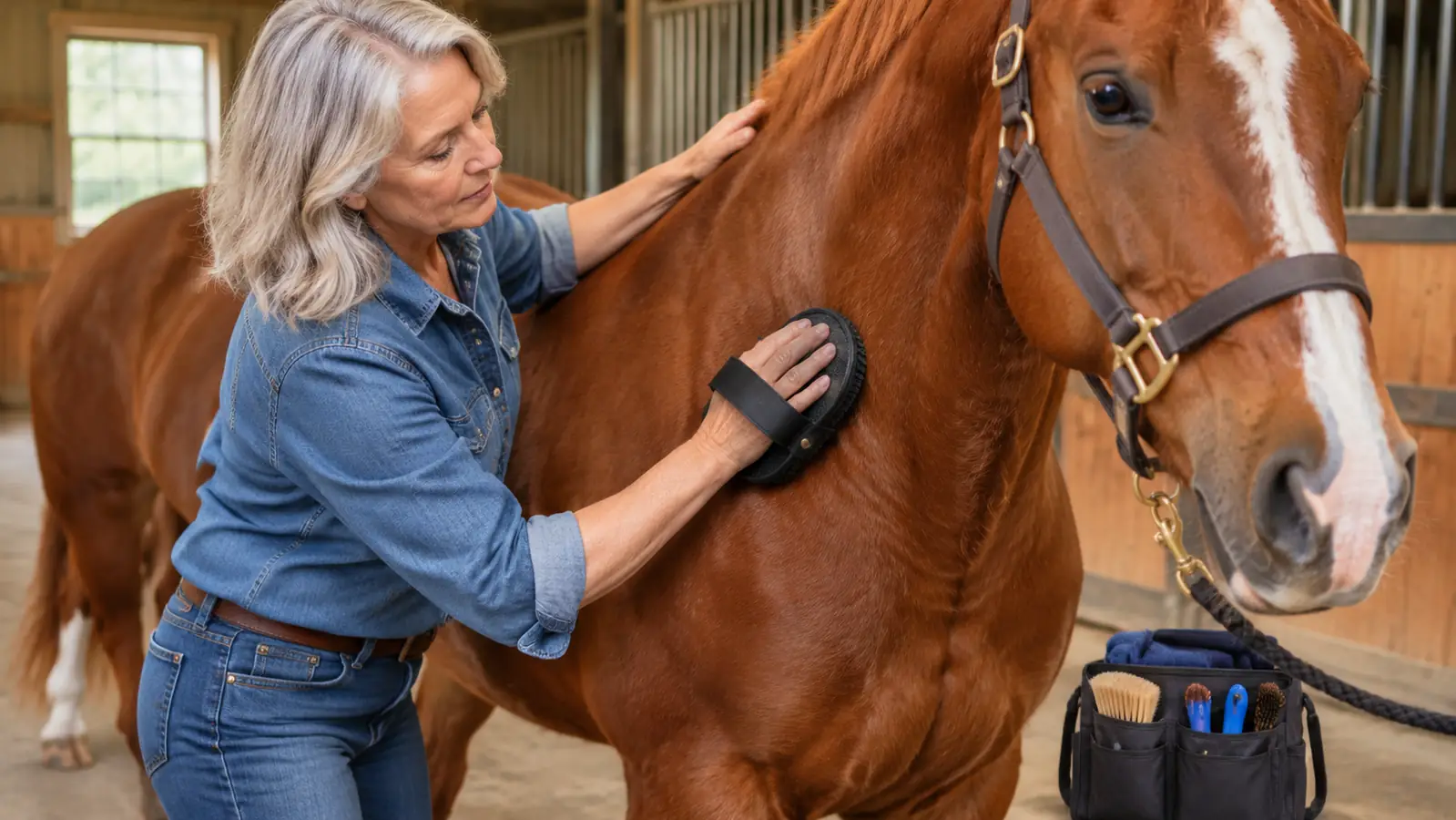
A curry comb you have to grip by a strap is a curry comb you set down. The palm-held curry in this kit sits flat against the hand, so I can work Ranger's shoulder and hip with one hand and keep the lead rope in the other. He gets girthy when the cinch goes tight too quick, and a few minutes of currying along his barrel before I saddle is the cheapest thing I do all day. I am not a trainer and I am not claiming this fixes a cinchy horse. I am saying a brush that stays in your hand gets used, and a brush in the bottom of a bucket does not.
The palm-held face brush reaches where a big brush should not go
This is the piece I did not know I wanted. Ranger has a white blaze and one white sock, and the white hair on his face shows every speck of dirt and every tear stain. A full-size brush against his cheek is too much brush. The small one goes down the blaze, along the jaw and under the chin without me poking him near the eye, and he stands still for it. The comb in the kit handles the forelock and the bridle path, and it does it without pulling.
One nylon tote replaces the bucket on the aisle floor
The Weaver Equine tote is the reason the kit works. The listing describes a nylon bag with six outer pockets and webbing handles, measuring 9.4 by 9.2 by 6.6 inches and weighing 2.67 pounds. Six pockets means the hoof pick has a pocket and the comb has a pocket and nothing ends up in a heap. It hangs on a hook just inside the barn door, so I grab the handle on the way past and I am done gathering. My old setup was a five-gallon bucket that collected rain water and spiders.
The hoof pick is in a pocket instead of under the bucket
The hoof pick is the piece I use hardest. We are on gravel road and Forest Service trail, and after a wet week in the Ozarks there is mud packed into Ranger's feet every single day. He is shod in front only, every six to seven weeks, and our farrier likes to arrive to clean feet. Having the pick upright in an outside pocket means I pick feet while I am already standing there instead of promising myself I will do it after. Anything about hoof health goes to our farrier and our vet, not to me.
The mane and tail brush ends the burdock fight
Ranger's tail is where the burdock goes to live. I used to work knots out with my fingers, which he tolerated and I did not. The mane and tail brush in this kit starts at the bottom of the tail and works up, and it does not rip half the hair out doing it. Same brush on the mane, and it handles the forelock. This is not complicated equipment. It is the right brush, in the bag, findable without a walk back to the tack room.
Everything hangs on one hook, so nothing walks off
That sounds like a small thing until you have spent a winter setting brushes on a feed tub lid and knocking them into the shavings. The tote lives by the barn door. The tack room at the end of the aisle holds the saddle and the padded halter, and that halter goes on Ranger for catching, grooming, tying, the farrier and loading in the trailer, never out to pasture. I tie him with a quick-release knot to a post, the same knot I have used for forty years, and grooming starts the second I catch him.
It comes apart into a wash bucket once a month
About once a month I fill a bucket with warm soapy water and wash the whole set. The listing gives the bristle material as horse hair and the handles as nylon, and they come out of a wash looking like themselves. I set them bristles-down on a board in the sun and the Weaver Equine brushes are back on the hook by evening. Brushes that can be washed are brushes that stay worth using. The old bucket set never got washed, because by the end I could not tell which brush was which.
Two and a half pounds rides in the trailer without a thought
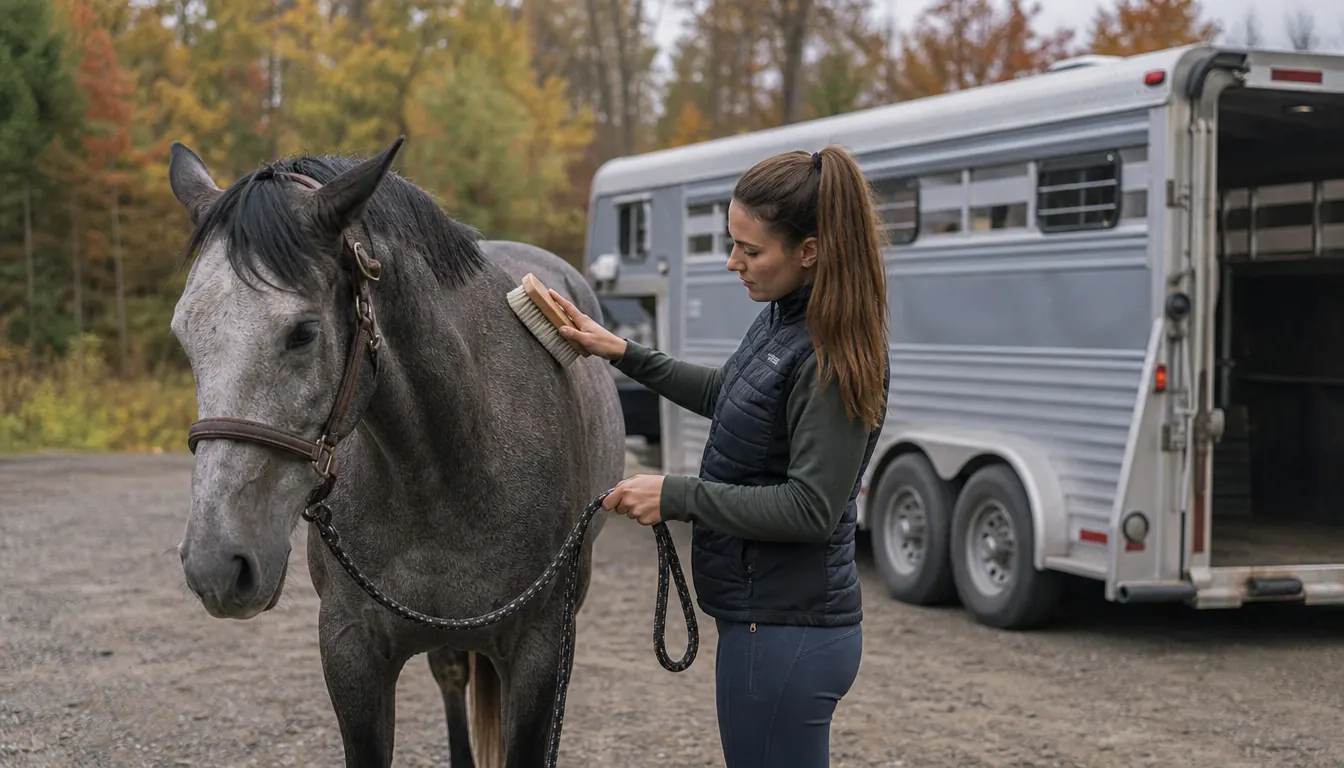
At 2.67 pounds the whole tote goes in the trailer without a thought. Once a month I load Ranger in the two-horse bumper-pull behind the pickup and meet friends for a longer ride, and I groom him at the trailhead before I saddle. Having the same brushes there as at home means I am not forgetting something. It also means a wet saddle pad goes onto a clean back, which is the entire point. The tote has ridden in that trailer for five months and the handles have not frayed.
Ten minutes of currying keeps the saddle pad honest
Ranger sweats heavily in an Arkansas summer. That is just the horse. What I can control is what sits between his skin and the pad. Ten minutes with the curry and the face brush before tacking up, and a rinse and a curry after, and the pad comes off clean instead of crusted. I am not going to tell you a brush prevents saddle sores, because that is a question for our vet and a fit question for someone who knows more than I do. I will tell you clean hair under a pad is easier on a horse than dirty hair.
Five months in, nothing has come apart
The bristles have not shed out, the tote stitching is intact, and the hoof pick is still a hoof pick. The Weaver Equine listing carries a warranty line reading Always Guaranteed, and 4.7 stars across 3,592 reviews, which is about what I would expect from a plain nylon and plastic set that does a plain job. It is not show equipment. It is the kit that hangs by the door and gets used, and for one trail horse that is the only test that counts.
What I'd Skip
Two things I would skip. The first is a second kit to keep in the trailer. The tote is light enough to carry out and back, and a duplicate set just means two hoof picks to lose. The second is a show bag with dividers and a shoulder strap, because six outer pockets and a pair of webbing handles on the Weaver Equine tote already do the organizing.
One honest note. I still reach for an old dandy brush I have had for years when I do Ranger's hindquarters, out of pure habit. That is me, not a knock on the kit. If you already own a big body brush you like, keep it and let the tote hold the rest.
Five months, three or four rides a week, and the only thing that changed is that I quit hunting for a brush.
The plain kit that earns its hook by the barn door
Comb, hoof pick, mane and tail brush, palm-held curry comb, palm-held face brush, and a nylon tote with six pockets. Five months of daily handling on one horse, and the Weaver Equine set still looks like itself.
Amazon Check current price on Amazon →