
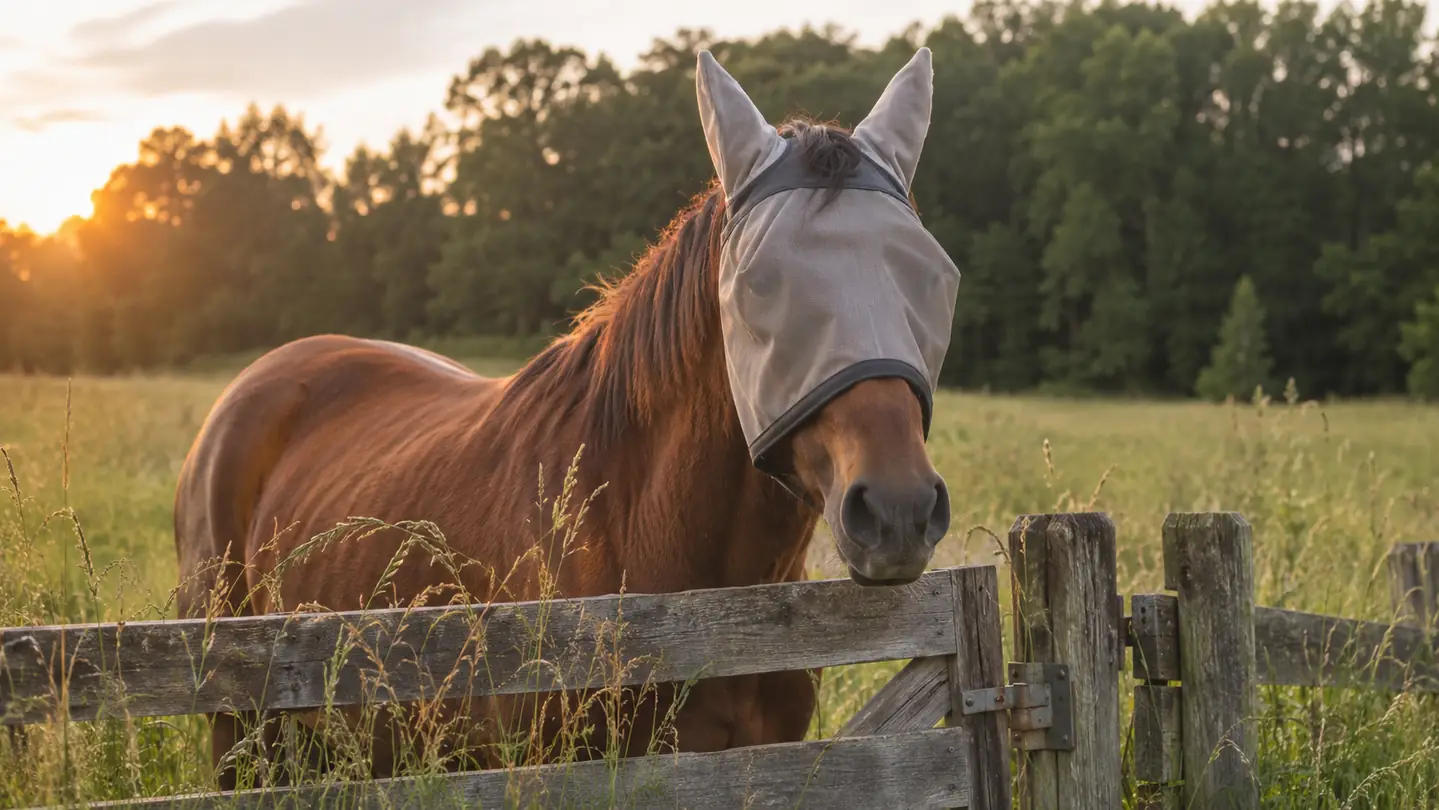
The first fly mask I put on Ranger was a feed store special with no ears, and it did not survive one summer. The hook-and-loop gave out sometime in July, the whole thing hung cockeyed off his jaw, and the gnats worked his ears anyway. He rubbed his head on the fence until his forelock looked chewed. So I did what I should have done the first time. I took a measurement, read a chart, and bought a mask built to stay where I put it. That was the Harrison Howard CareMaster Pro, and it is the one Ranger wore from May to mid-October this year.
Here is the order I wish somebody had handed me back then. None of it is complicated, and very little of it is about which brand you buy. A good mask in the wrong size will rub a horse worse than a plain one that happens to fit. The fit is the part you control. Ranger is a 14-year-old Quarter Horse gelding, 15.1 hands and about 1,050 pounds, and he is not patient about his ears. If this works on him, it will work on most horses.
The Size Chart Is on the Listing, and Reading It Takes Two Minutes
Match the measurement you just took to the maker's own chart instead of guessing from a halter size. The CareMaster Pro listing carries the size options and the measurements that go with them, so you can order once and be done.
Amazon Check Sizes and Today's Price on Amazon →Step 1: Measure the Head, Not the Halter
A halter size tells you nothing useful here. Ranger wears an average horse halter and a large fly mask, and that is normal. A halter is sized around the nose and the throatlatch. A fly mask is sized around the whole head, and the ears and the brow change the answer. Do not order the size your friend orders or the size the last horse in the barn wore. Those are two different heads.
Tie your horse somewhere safe, with a quick-release knot if you are tying to a post, and use a soft cloth tape or a length of baler twine you can mark with a pen. Start under the jaw at the point of the cheek, run up the side of the face to just below the base of the ear, then carry it across the forehead to the same spot on the far side. Write it down before you let the twine go. If your horse is head shy, do it in the stall while he is eating, and finish it tomorrow if you have to.
The number around the brow and cheeks matters most, but the drop from the brow to the point of the jaw matters too. A mask that is long enough but narrow will pull tight over the eyes and leave a gap at the throatlatch. A mask that is wide enough but short will ride up behind the ears. Take both and you can tell which way a chart is likely to fail you.
Step 2: Match the Number to the Maker's Chart
Every maker draws its chart differently, so the number you took is only useful against the chart for the mask you are actually buying. The Harrison Howard CareMaster Pro listing carries its size information and the measurements that go with it, and I matched ours to that, not to a chart I found somewhere else on the internet. Manufacturer's number, manufacturer's chart. It sounds obvious and people get it wrong constantly.
Do not size up. Every fly mask I have seen fail has failed by being too big. There is a little voice that says a roomier one will be cooler, or will leave room to grow, or will be easier to get over the ears. A horse does not grow much between May and October. A loose mask slides sideways, gaps at the cheek, and lets the midges in through the gap. The CareMaster Pro has thick fleece padding along the edges for exactly this reason, and padding only does its job when the mask is snug against it.
If your horse lands between two sizes, look at how the edges are built before you decide which way to go. Soft padding and secure touch closures will forgive a slightly close fit. Nothing forgives a loose one, because the horse rubs it, and once a mask starts getting rubbed against a fence post it is finished. I would sooner go down a size and check the eye clearance than go up a size and hope.
Step 3: Put It On Nose First, Then Ease the Ears In
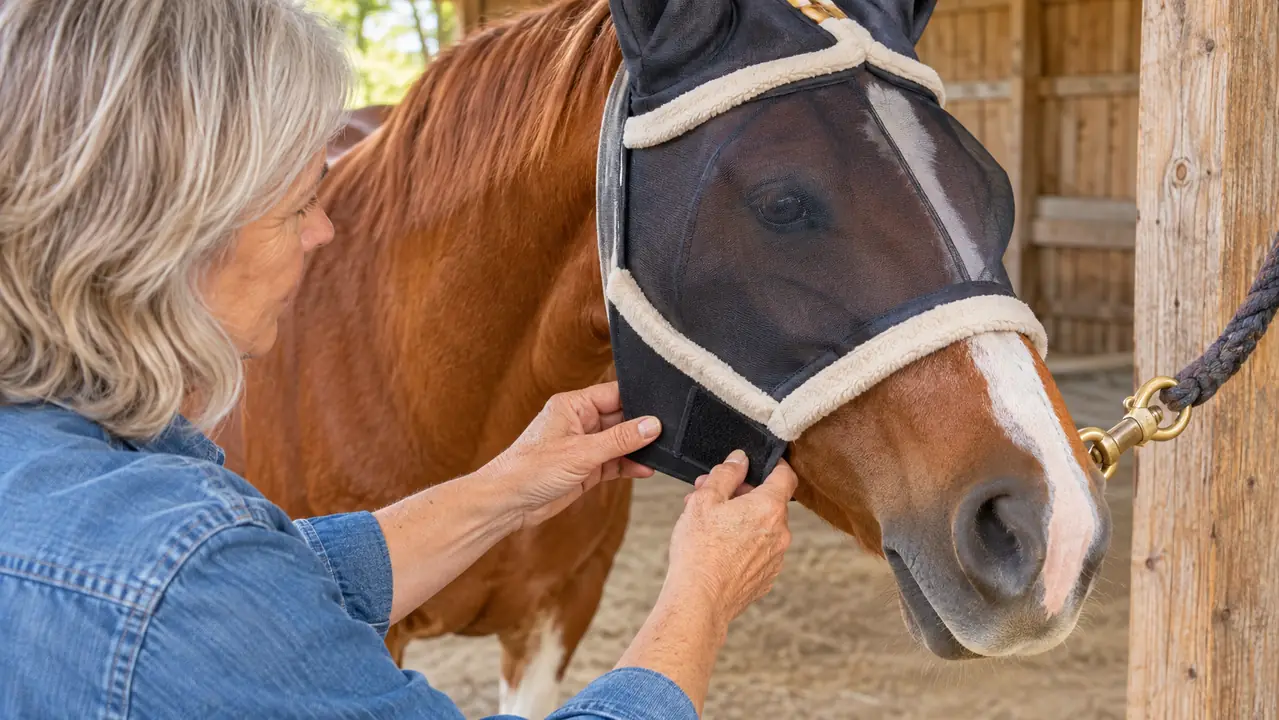
This is where most people lose the fight, and it is usually not the horse's fault. Put the mask on nose first. Slide it up over the muzzle and the cheeks, bring the brow into place above the eyes, and only then deal with the ears. Start at the ears and the horse throws his head, and now you are chasing him around the dry lot with a piece of mesh in your hand.
One ear at a time. Fold the ear cover back on itself, ease it over the ear from the base up, then let it settle. Ranger is herd sour and fussy about his ears, so I do the near side first, every single time, and I talk to him while I do it. Same order, same hand, same voice. Horses learn a routine fast and fight a surprise. If an ear cover will not go on without a real argument, the mask is too small, and no amount of patience is going to fix that.
Then close the throat closure. The CareMaster Pro uses touch closures, and the two sides should sit flat against each other with no grit between them. Do not haul it down like a cinch. Snug enough that the mask does not travel, loose enough that you can slide a finger under the strap. Ranger pins his ears if anything is tightened on him too fast, so I close it in two passes. Set it, then snug it.
Step 4: Check Four Pressure Points and the Eye Space
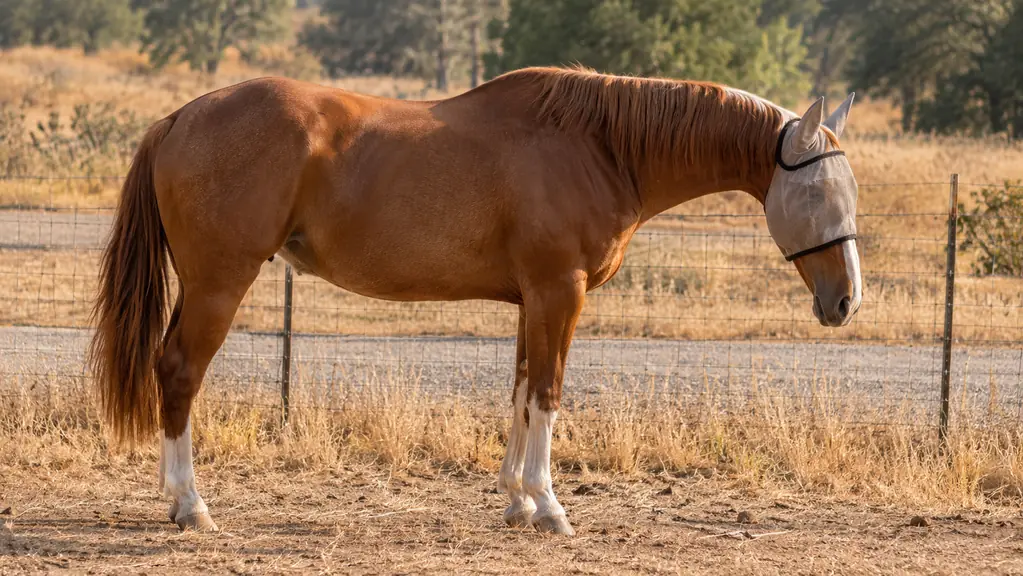
Once it is on, run your hand around the edges. Four places cause trouble: under the jaw where the closure sits, behind the ears where the covers meet the head piece, across the brow, and along each cheekbone. Slide a finger under the padding at each one. If you cannot get a finger in, it is too tight. If two fingers slide in easily, it is too loose and it will move.
Then look at the eyes. The mesh should sit off the eye itself with clear space, which is the whole point of the wide eye space on the Harrison Howard mask. The translucent fine mesh lets you see the eye through it, so check from both sides, not just the side you are standing on. An eye that is squinting, watering more than usual, or has a fold of mesh pressed against it means the mask is sitting wrong or is the wrong size. Take it off and start over.
Watch him for the first ten minutes. Ranger told me everything I needed the first morning. He shook his head twice, walked a lap, put his head down and grazed. A horse that keeps shaking, rubs his face on a fence, or holds his head to one side is telling you something is pinching. Do not leave it on him and hope it settles. It does not settle. It rubs.
Check it again after a week of wear. New masks stretch a little at the closure and the padding beds down against the face, so what was snug on day one can be loose by day eight. That second check takes a minute and it is the one most people skip. It is also the one that catches a mask starting to travel before the horse has a chance to rub it crooked.
Step 5: Wash It, Dry It, and Take It Off at Night
Ranger wears his from morning turnout to evening feeding, and that is all. He does not wear it overnight and he does not wear it under a bridle. Overnight is when a horse has hours to work a mask loose against a fence or a water trough, and there is nothing to gain after dark anyway. I take it off at feeding, look at his face, and hang the mask on a hook.
Wash it every couple of weeks, or whenever the fleece starts looking grim. Warm water, a little mild soap, work it with your fingers, rinse until the water runs clear, and dry it flat in the shade. Not the machine, and not baking in full sun. The material is breathable and midge-proof, and heat is what kills that kind of fabric. The Harrison Howard mask gets washed in the same bucket I use for the brushes and hung over the rail to drip.
Check the closures every day. The feed store mask Ranger had before this one died at the hook-and-loop, not at the mesh. Grit gets in, the hooks stop grabbing, and one morning the whole thing is hanging off one ear. Brushing the closure out when you take the mask off in the evening is the cheapest maintenance there is. At the end of the season, wash it, dry it completely, and put it away somewhere dry where mice cannot get at the fleece.
What Else Helps
A clean face makes a real difference. Grit and dried sweat under fleece padding is what rubs a horse, not the mask itself. I run the palm-held face brush from my grooming kit over Ranger's head before the mask goes on, and I keep a soft cloth in the tack room for the corners of his eyes. It takes thirty seconds. It is also the difference between a mask that lasts a season and one that leaves a bald patch across the brow.
Spray the body, not the face. Fly spray under a mask soaks the fleece and holds the dust, and then you have a wet pad pressed against the horse's cheek all day. I spray his chest, legs and belly and let the mask handle the head. I keep his forelock trimmed enough that it does not wad up under the brow, because a wadded forelock pushes the mask forward and pulls the eye space down onto the eye.
Keep the routine boring. Ranger gets caught with a halter, groomed, masked, and turned out, in the same order at the same time. The halter comes off before he goes through the gate, always. A halter left on in the pasture is how horses get hung up, and a mask is no different in that respect: it goes on for turnout, comes off at feeding, and gets hung on its hook where I can find it in the dark.
And know what a mask will not do. It will not stop a horse from scratching his face on a fence, and it will not fix an eye that is running for some other reason. Ranger's eyes watered constantly before he had this one, and with it on and fitted properly the watering stopped inside a couple of weeks. If the watering continues with the mask on and the fit checked twice, that is a call to our vet, not a reason to go buy a different mask.
Five and a half months, May through mid-October, morning on and evening off. The fleece padding is still flat where it should be and the mesh is still off his eyes.
One Season, One Mask, and a Chart That Got It Right the First Time
If you take the measurement and match it to the maker's chart, this is a mask you put on in the morning and stop thinking about. Ranger wore his through a full Arkansas fly season and it is washed and waiting for next May.
Amazon Check Today's Price on Amazon →