
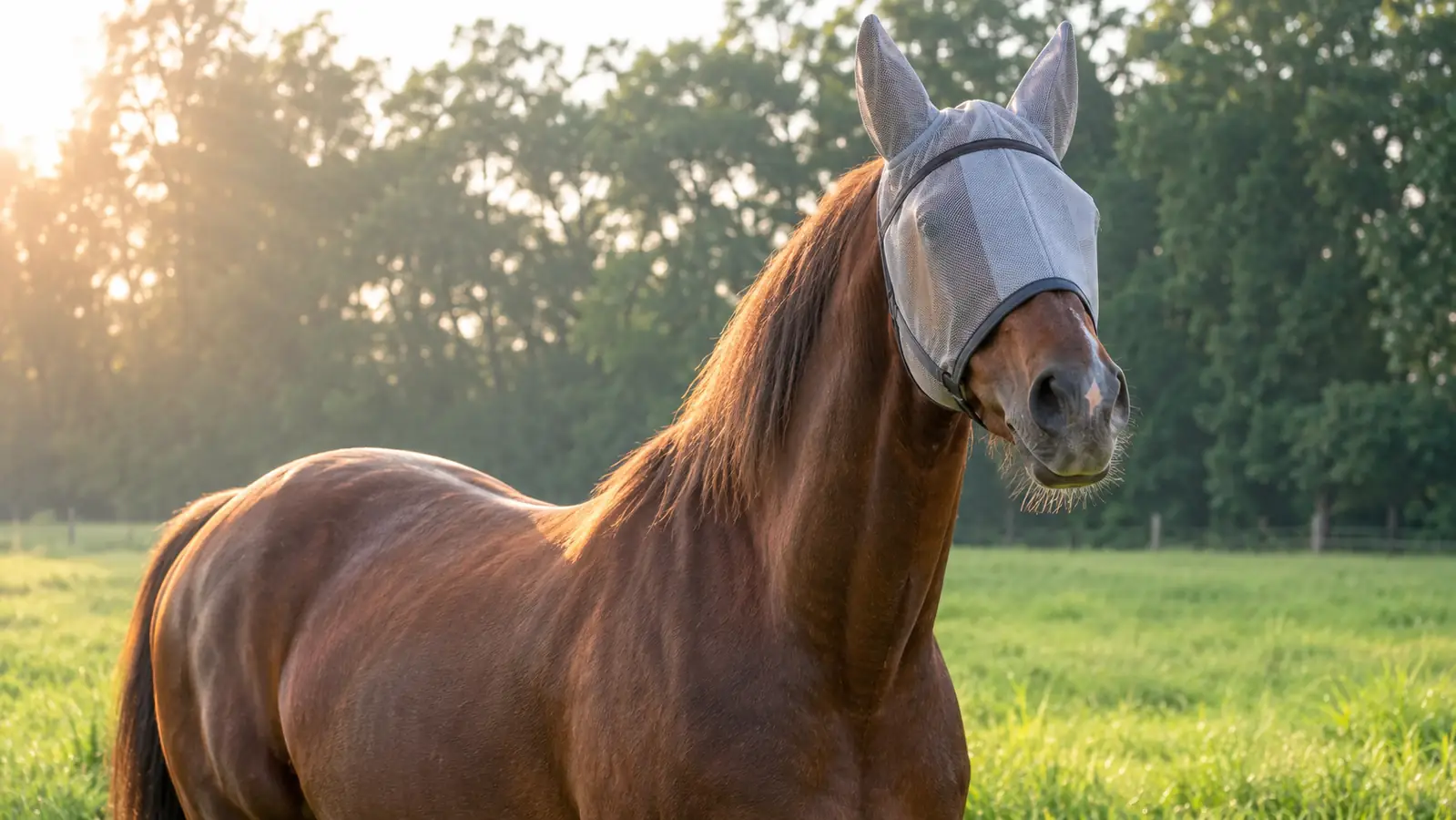
Ranger's ears have always been the first thing to go in fly season. Not his eyes, not his flank. The ears. Gnats find the inside of a Quarter Horse's ear the way flies find a screen door, and by the second week of May he was head-shaking at the gate before I could get a halter on him. I bought the Harrison Howard CareMaster Pro fly mask with ears in late April 2026, after a cheap feed-store mask without ears came apart at its closure in its first summer and left the ears bare anyway. He wore this one every day from May through mid-October, about five and a half months, and it is washed and folded into a feed sack in the tack room right now, waiting for next spring.
I am not a trainer and I am not a vet. I am a retired rural mail carrier with one horse, six acres and a saddle I have had for years. Ranger is a 14-year-old sorrel Quarter Horse gelding, 15.1 hands, and he sweats hard in an Arkansas summer. What follows is what I noticed from the barn aisle, not from a laboratory. If you want the short version, it is a few lines up. If you want to know whether it will survive your horse, keep reading.
The Quick Verdict
Five and a half months of daily turnout on a horse with touchy ears, and the head-shaking stopped inside two weeks. It is still in one piece. It just looks like it has been used, because it has.
Amazon Check Today's Price →The Ears Are the Reason to Buy It
Ranger went from head-shaking at the gate to standing quiet for the halter. Same pasture, same gnats, same horse. That is the part I would pay for again.
Amazon Check Today's Price on Amazon →How I've Used It
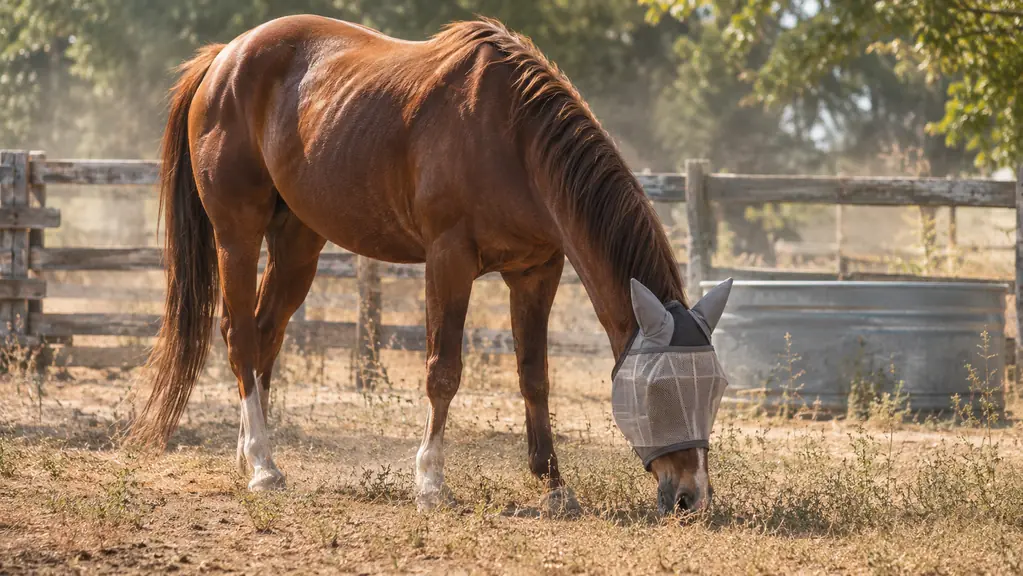
Ranger goes out to the pasture after his morning feed and comes back in at evening feeding. The mask goes on before he walks out and comes off before he gets his grain. He has never worn it overnight and I have never ridden him in it. That works out to roughly 170 days of daily turnout, plus a scattering of late April days when the gnats came early. On the two occasions I got distracted and left it hanging on the gate hook, I could tell by early afternoon. He would be standing at the water trough rubbing the side of his head on the post, and I would have to walk back down and fetch it. The first morning I put it on him it took me four tries to get the closures to sit even, and I had a bucket of feed in one hand the whole time. By the end of that first week it was a fifteen second job. The ears have to go in before the fabric settles, and if you rush that part the ear covers end up folded under and the horse tells you about it.
Fit is where most of these go wrong, so I want to be plain about it. We followed the size chart on the listing instead of guessing from a photograph. Ranger is 15.1 hands and right around 1,050 pounds, and the chart put him in the full size with room to spare. Harrison Howard cut it anatomically, meaning the eye area is shaped out rather than pulled flat across the face, and on my horse that shaping is why it sits where it should. If your horse is between sizes, measure with a soft tape the way the chart says and write the number down. Do not eyeball it. I have watched a friend eyeball a fly mask and she spent June with it half over one eye.
Care is a bucket of warm soapy water about every two weeks in the worst of the season, then a rinse from the hose and a few hours drying flat in the sun on the porch rail. The ear covers get worked with my fingers in that bucket, because that is where the dust packs in hardest. Twice over the summer I found a burdock burr wedged down in the fleece seam and picked it out with the tip of a hoof pick, which is not what a hoof pick is for, but it worked and the seam did not open. It went into the feed sack clean and dry in the third week of October. That is the whole regimen. No special soap, no machine.
What the Mesh and Padding Actually Do
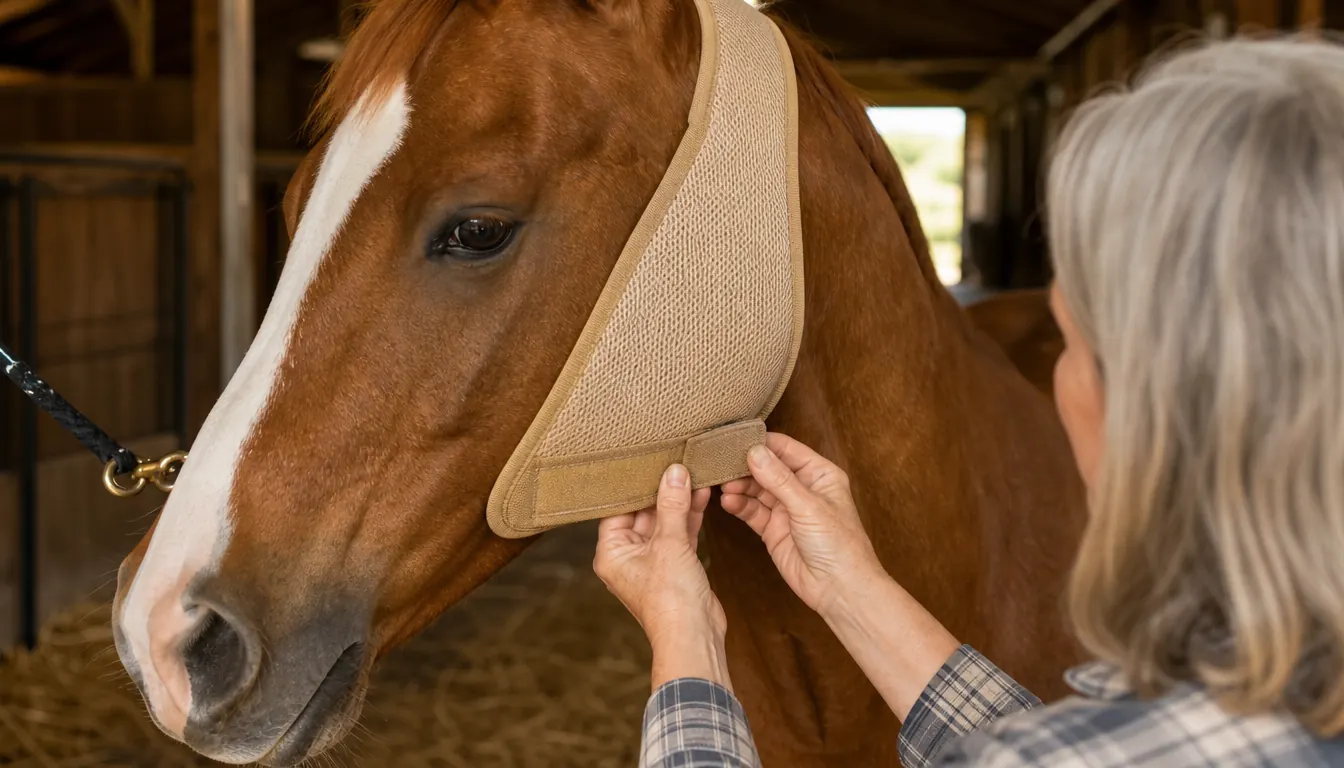
The body of the mask is a translucent fine mesh, and translucent matters more than it sounds. I can see Ranger's eyes through it when I walk up to him in the pasture, which means I can see whether he is squinting or whether something has gotten in there. A solid dark mesh would have been a black box on his head all summer and I would have been lifting it to check him. The listing calls the UV protection lab tested, and while I am not going to pretend I tested that myself, I can tell you his face did not sunburn and the white blaze on his nose did not pink up the way it did the summer he went without a mask.
The edge is thick fleece padding, and that is the part I expected to fail first. Padding that rubs is worse than no padding, because a horse will rub at a sore spot until he makes it worse. Ranger wore this from May to October with the fleece sitting across his cheekbones and down the line of his jaw, and when I pulled it off in October there was no bare patch and no dent in the hair. I checked him every single evening at feeding, running two fingers under the edge where it crosses the cheek, and not once did I find a spot that felt warm or crusted. The padding sits where it should because the mask is cut to the shape of a horse's head rather than being a bag with two holes in it. The listing says the fleece prevents pressure marks and closes gaps, and from five and a half months of looking at my own horse, I will agree with the gaps part. The gnats never found a way under the edge.
The closures are the secure touch type, and they held. Not once did I walk out to the pasture and find the mask hanging off one ear because Ranger had worked it loose rubbing on the fence. It also weighs very little, 6.7 ounces on the listing, which matters more than people think on a hot day. A heavy mask gets rubbed off. This one he mostly forgot about.
The Ear Covers Were the Whole Reason I Bought It
I want to be honest about why I replaced the old mask. It was not the eyes. The feed-store mask covered his eyes well enough. What it did not do was keep anything off his ears, and the ears were the problem. Ranger would stand in the shade of the run-in shed with his head down and his ears going like a metronome, and on the bad days he would rub the side of his head against the shed post until the hair was thin. Gnats get down in the ear and there is nothing a horse can do about it. Our vet looked at him that spring and said the ears were irritated but not infected, and asked what I was using for fly protection. That was the nudge I needed.
The ear covers on this mask come down over the ears and stay down over the ears. He can still move them. I have watched him track a sound across the pasture with the covers on, and they move under the fabric the way ears should. He did not love it the first two mornings. He shook his head twice and walked a circle in the dry lot before he settled. By the end of the first week he was dropping his head for me to slip it on, which is the only review from a horse that means anything.
Five and a Half Months in an Arkansas Summer
Our summers run hot and wet and then hot and dry, and a horse that sweats the way Ranger does will test anything you strap to his head. He sweated through it. The mesh breathed well enough that he never came in with a soaked forehead, and I credit that partly to the mesh and partly to it being a light mask. Rain was the harder test. On a Thursday in early July we got a hard line of storms through about three in the afternoon, and when I went down to bring him in the mask was hanging heavy and dark with water, the ear covers plastered flat to his head. He was not in distress, but he was not happy either. I took it off, wrung what I could out of the fleece, and let it dry over the stall door overnight. It came back to shape and went out again the next morning.
By mid-October the Harrison Howard mask was grubby and the edges had a soft fuzz on them from five months of pasture and fence posts. That is what use looks like. The closures still caught. The fleece was flattened but intact. The mesh had no holes in it and the ear covers were still sewn on. I gave it a last wash, let it dry on the porch rail, and folded it into a feed sack with the rest of the season's gear. I expect to get at least one more summer out of it, maybe two.
What it does not do is protect the whole horse. It is a head mask. Ranger's throat, chest and shoulders still get worked by flies, and no fly mask is going to change that. If your horse is being eaten alive on his body, this is one piece of a bigger answer, not the answer by itself.
By the second week of June the head-shaking at the gate had stopped. Same pasture, same gnats, same horse. That is the only test I actually care about.
The Parts That Annoyed Me
Getting the closures lined up takes two hands. On a calm morning that is nothing, you slip it over the head and press. On a windy morning with a horse who wants his breakfast, the loose side flaps before you get it fastened and you are standing there holding a mask and a horse at the same time. There was one morning in August with the wind coming out of the west ahead of a storm, and I ended up putting the lead rope over the gate and doing it one handed because Ranger would not stand. I got it on. It took a minute instead of fifteen seconds. I would not call it a one-handed job on a normal day. And the ear covers collect burdock. If your pasture has burdock, and mine does along the fence line, you will be picking it out of the ears once a week with your fingers.
On the hottest afternoons, the ones where the air does not move at all, I took it off early a few times and let him stand in the shed with the fan going. He was sweating under it on those days. Not badly, and not the way he sweated in the old solid mask, but enough that I made a judgment call. I would rather tell you that than pretend it is weightless in a hundred degrees. Sizing also runs generous on this one, so measure. And the mesh holds dust. A quick rinse does not cut it by August, you need the soapy bucket.
What I Liked
- Ranger stopped head-shaking within about two weeks of daily wear
- The ear covers stay over the ears and he can still move them normally
- Thick fleece edge left no rub marks across five and a half months
- Translucent mesh lets you see the eyes without lifting the mask
- Touch closures held through turnout, sweat and rain
- Washed up and went into winter storage still in one piece
Where It Falls Short
- Takes two hands to line the closures up on a windy morning
- Burdock and dust collect in the ear covers and the mesh
- Gets heavy with water in a hard rain
- Sizing runs generous, so follow the chart instead of assuming
- Covers the head only. Flies still work the throat and chest
- On the stillest, hottest afternoons I took it off early
Who This Is For
This is for the owner whose horse has trouble with his ears in fly season. The head-shaker, the shed-rubber, the one who stands with his head down and his ears going. If you have already tried a no-ears mask and the ears were still the problem, that is exactly the gap this fills. It also suits a horse that lives out during the day and comes in at night, because it goes on and off easily enough for a twice-a-day routine, and it suits anyone who wants to be able to see their horse's eyes without taking the mask off to check. If you are trail riding and want something for the trail, this is not it, and I would not use it under a bridle.
Who Should Skip It
Skip it if your problem is flies on the body rather than the head, because this will not help you and you will be disappointed. Skip it if your horse has a history of getting masks off no matter what you do, since anything with a closure can be defeated by a determined horse and the answer there is usually a different setup, not a different mask. Skip it if you want a mask for turnout overnight without checking, because I never left one on mine overnight and I would not start now. And skip it if you are not going to wash it. Five months of sweat and dust in a mesh is a skin problem waiting to happen, and that is a job for our vet, not for me.
One Fly Season Is Enough to Know
It came off in October, got washed, and went into a feed sack for winter. Next May it goes back on Ranger's head. That is as strong a recommendation as I give anything.
Amazon Check Today's Price on Amazon →