
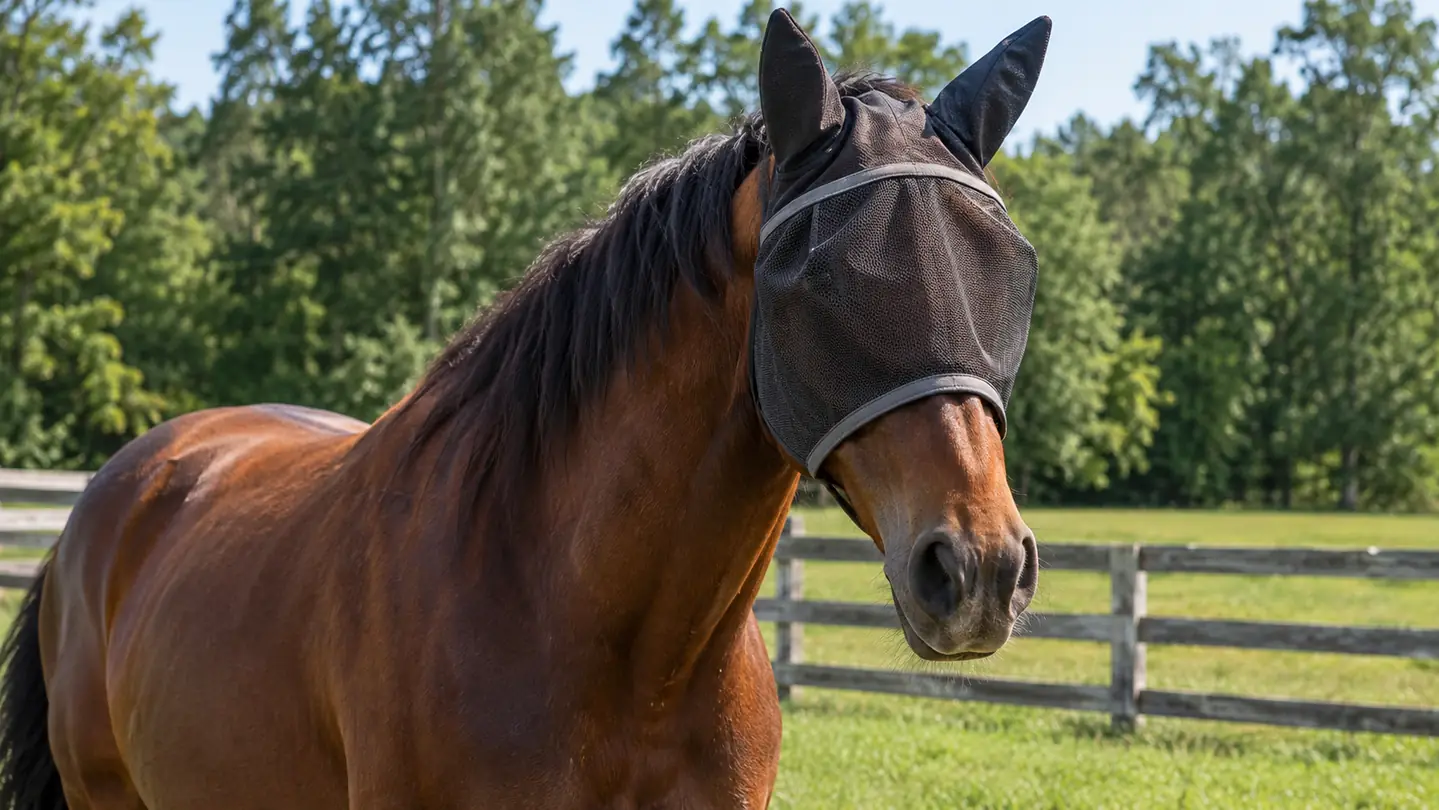
Ranger has a white blaze, one white sock on the left hind, and no patience at all for anything flapping around his ears. Last summer he wore an inexpensive feed-store fly mask that gave up at the closure before the Fourth of July, and by August the gnats had his ear tips rubbed raw again. So in late April, when I went looking for a replacement, I did what I always do. I read every listing twice, then asked around. Two names kept coming back: the Harrison Howard CareMaster Pro and the Farnam SuperMask. I bought the CareMaster Pro. I have never owned the Farnam. What follows is what five and a half months of daily turnout did to the one I did buy, set next to what the Farnam listing and two riding friends say about the other.
Short answer, if you are in a hurry. On a horse with a broad face who rubs his head on fence posts, the Farnam SuperMask is the safer bet, and I say that without having owned one. On a horse whose eyes water and whose ears get worked no matter what you hang on him, the Harrison Howard CareMaster Pro is the mask I would buy again tomorrow. The rest of this is my reasoning, and there is a fair amount of it, because a fly mask is not complicated until it is sitting on a 1,050 pound animal in an Arkansas August.
| Harrison Howard CareMaster Pro | Farnam SuperMask | |
|---|---|---|
| Ears | Built in on the model I bought | Sold with ears and without, so read the listing closely |
| Eye clearance | Large eye space, mesh stands off the eye | Standard eye opening, sits closer to the face |
| Edge padding | Thick fleece along the brow and edges to close gaps | Fleece browband, lighter padding overall |
| Closure | Touch closures | Hook-and-loop straps under the jaw that friends say stay put |
| Mesh | Translucent fine mesh with a lab-tested UV protection claim | Soft mesh with a long track record behind it |
| Sizing range | Sold by size off a chart, no oversize | Runs up past standard, which matters on a wide head |
| Best for | Horses whose eyes water and whose ears take the hits | Horses that rub masks off and need a bigger fit |
A word on how I built that table. Every row on the left comes from the mask hanging in my tack room right now, and from the listing I ordered it off. The listing lists it at 6.7 ounces and calls the eye space large, and I can tell you the weight feels about right in the hand, lighter than the old feed-store mask it replaced. Every row on the right comes from the Farnam listing as I read it and from Bonnie and Deb, who between them have run SuperMasks for years. I have not put one on Ranger, so I am not going to pretend I have.
Where the CareMaster Pro Wins
The eye space is the reason I bought it and the reason I would buy it again. The mask is cut so the mesh stands away from the eye instead of lying flat on it. Ranger's eyes have run every summer I have owned him, from the first warm week in May until the flies quit. Last year they ran for about two weeks after I put this on him in late April, and then they stopped, and they stayed stopped until I took it off in October. I did not change anything else about his routine. Same pasture, same feed, same muck pile. It was the mask.
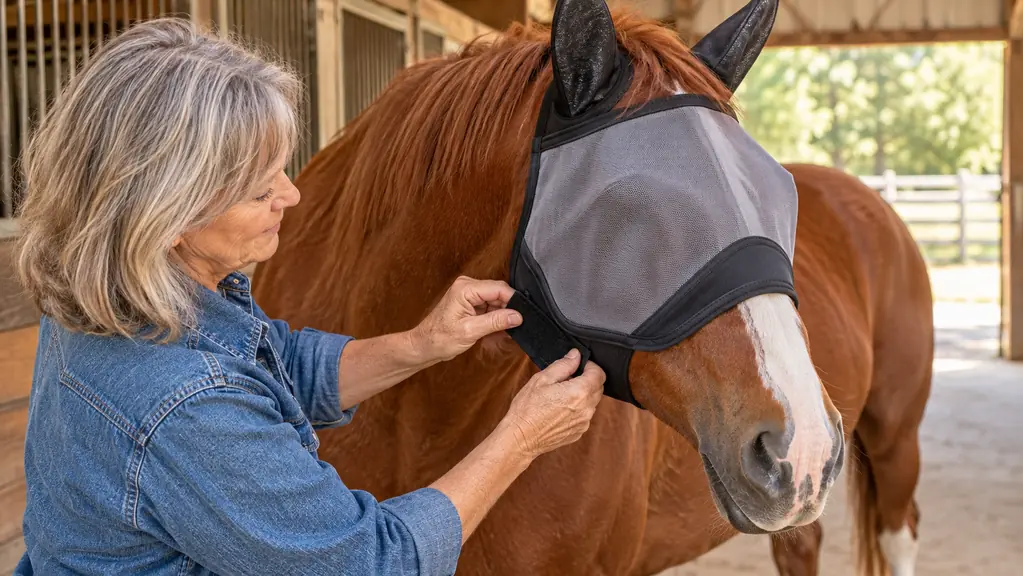
The second thing is the padding. Thick fleece runs around the edges, and the whole job of that fleece is to close the gaps where a lighter mask rubs a bald spot into the hair over the cheekbones. Ranger had two thin patches from the old feed-store mask that took most of a winter to grow back in. They grew back. The fleece is also why I think the mask stays where I put it. It is not gripping him by the ears, it is sitting on padding, and he has never once made the face he makes when something pinches.
I will add one more, because it is the kind of thing that decides whether you actually use a mask or leave it hanging. The first week I had it, I did the thing I always do with new gear, which is stand at the gate and watch him for ten minutes instead of going back to the house. He grazed. He drank. He walked the fence line the way he does when the wind is out of the south. He never once shook his head or tried to rub it off on the water trough, and that trough has taken more gear off that horse than any fence post on the place. If a mask is going to come off, that is where it happens, and it did not.
Last thing in this column, and it surprised me: the mesh is translucent enough that he can still see. I expected him to be spooky in it for a week. He walked out to the pasture the first morning like he had worn it his whole life. I put that down to being able to see through it, and I have watched him step over a root in it more than once without breaking stride.
Where the Farnam SuperMask Wins
Bonnie has used Farnam SuperMasks for years, on a mare that treats every piece of headgear like a personal insult. What she stays for is the closure. She says the straps under the jaw hold where other masks let go, and that her mare, who can get a mask off in a pasture full of nothing to rub on, has not managed it with the Farnam. I believe her. Ranger is not that horse. He is herd-sour leaving the barn and girthy about the cinch, but he has never in six years tried to remove anything from his own head.
Deb's reason is different and it is worth hearing. She has a gelding with a wide forehead and she went through two masks that fitted everywhere except across the brow, and a mask that is tight across the brow is a mask that ends up over one ear by noon. She has run a SuperMask for three summers now and says the top end of the size run is what keeps her in it. That matches what I read in the listing.
The other place the Farnam clearly has the edge is the size range. It runs up past standard, and that matters if your horse has a head like a fence post. We followed the size chart on the CareMaster Pro and got a good fit on Ranger at 15.1 hands and about 1,050 pounds, so I have no complaint. But if I had a big warmblood or a draft cross, I would want the oversize option, and the Harrison Howard CareMaster Pro does not list one. That is a real limitation, not a small one, and it is the reason I would not tell a draft owner to buy what I bought.
The one I bought, washed, and put away for next May
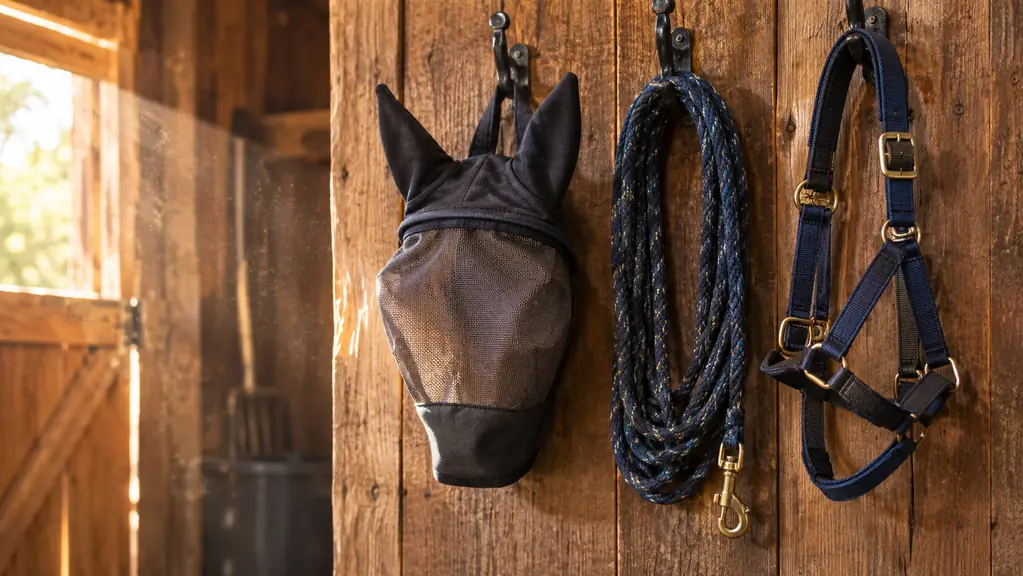
Ranger wore the Harrison Howard CareMaster Pro on every turnout from late April to mid-October. It is in a feed sack in the tack room right now, waiting for spring, and it still holds together.
Amazon Check Today's Price on Amazon →What Five and a Half Months Actually Did to It
The routine never varied. On in the morning when he went out to the pasture, off at evening feeding. He never wore it overnight. He never wore it while I was on his back, mostly because I want to see his ears working when I am riding and partly because a mask and a bridle are two things competing for the same real estate. So call it twelve hours a day, five and a half months, which is somewhere north of 1,800 hours of Arkansas summer on one piece of gear.
It still holds together. There is some fuzz along the edges where the fleece has worn against the mesh, and the whole thing has softened up the way a good cotton shirt does after a season. No stitching has let go. The touch closures still grab. The mesh has no holes in it. I am not going to tell you it looks new, because it does not, but I have thrown away three fly masks in six years and this is not going to be the fourth.
The closures deserve a note of their own, because that is where the cheap mask died. Every couple of weeks I sit on the tack room step with it in my lap and pick the hair out of the hook side with my thumbnail. That is two minutes of fiddly work and I would rather do it than have a closure let go in the pasture. The one time I got behind on it, the hair had built up enough that the closure was only grabbing about half its width, and I could feel it. Cleaned out, it grabs like it did in May.
Ranger's eyes have run every summer I have owned him. Two weeks into the CareMaster Pro they stopped, and they stayed stopped until I took it off in October.
I washed it twice during the season, by hand in a bucket of warm water with a little soap, and let it dry flat on the porch rail out of direct sun. That is not a special method, it is just what I do with anything that has fleece on it. It came out of the wash holding its shape. In mid-October I gave it a last wash, let it dry a full day, and it went into a feed sack on a shelf in the tack room with the ear pieces folded flat so they would not crease.
The Ear Problem, and Why It Mattered
The old mask had no ears. That was the whole failure, really. The closure tore in the first summer and after that it hung loose, and loose meant flies could get in at the ear tips. Ranger's ears are thin-skinned and he will shake his head for an hour if something is bothering them. By August of that year the tips were scabbed and the hair was gone and I was out there with a fly wipe twice a day, which he hated and I did not enjoy either.
I tried the obvious things first and none of them lasted. I dabbed the wipe on in the morning, and by evening the sweat had taken it and the gnats were back. I tried pulling a light cotton fly sheet over him, and that helped his back and shoulders and did nothing at all for his ears. I even tried smearing a little petroleum jelly around the ear base, which worked for about a day and collected grit until he rubbed his head on the run-in shed and made it worse. A mask with ears built in is the only thing that solved it in one step.
The CareMaster Pro has the ears built into the mask as one piece, so there is nothing to come loose or get lost in the pasture. Within a couple of weeks the scabbing was gone and the hair was coming back. That is not a medical claim and I am not a vet. It is one horse, one summer, and what I saw with my own eyes in my own dry lot. If your horse has a genuine ear problem, call our vet, not a fly mask.
What I Liked
- Large eye space keeps the mesh off the eye instead of on it
- Thick fleece edges close the gaps where lighter masks rub
- Ears are built in, so nothing comes loose or gets lost
- Translucent mesh, and Ranger could see through it from day one
- Held together through five and a half months of daily turnout
Where It Falls Short
- No oversize option, which rules it out for a wide or draft head
- Touch closures collect hair and need picking out every couple of weeks
- It is a daytime turnout mask, not something to leave on overnight
- The fleece softens and fuzzes at the edges after a season
The Fit Question
We followed the size chart. That is the whole of my advice on fit and I will say it plainly, because I have watched people guess at headgear and then blame the headgear. Measure, look at the chart, order the size the chart says. The CareMaster Pro is anatomically shaped, which sounds like a catalog phrase until you put it on a horse and notice that it sits the way a head is actually built rather than the way a bag sits on a box.
I measured Ranger with the sewing tape measure I keep in the tack room, the same one I used on my own head for the helmet in the spring. I wrote the number on the inside of the tack room door with a pencil, which is where every measurement on this place ends up, and I read the chart against it. I will not hand you a number, because Ranger is not your horse and the chart will tell you more than I can. But I will tell you that the number on that door has saved me from ordering the wrong size twice now, and it is worth the ten minutes.
If you are between sizes, or if your horse is genuinely wide across the forehead, I would go the other direction. The Farnam runs bigger at the top end and that is a fair reason to buy a Farnam. There is no shame in buying the mask that fits the horse you have. What I would not do is buy a size too small and hope the fleece makes up the difference, because fleece does not make up the difference. It just rubs somewhere new.
Who Should Buy Which
Buy the Harrison Howard CareMaster Pro if your horse's eyes water every summer and the flies work his ears no matter what you put on him, and if he is an ordinary-sized horse you can size off a chart without guessing. That is Ranger exactly, and I got a full season out of one mask with fuzz on the edges as the only wear. Buy the Farnam SuperMask if you have a wide or oversized head to fit, or if you have a horse that has already learned how to get a mask off and you need a closure that will not let him. Bonnie would tell you the same thing over the fence and she has been right about more horses than I have. Either way, put it on in the morning and take it off at night, wash it when it gets grim, and do not leave it on a horse turned out with a fence post and nothing better to do.
One mask, one season, one horse that stopped rubbing his ears
The Harrison Howard CareMaster Pro is the mask I will be putting back on Ranger next May. Order off the size chart, and if you have a wide head to fit, look hard at the size range before you do.
Amazon See the CareMaster Pro on Amazon →