
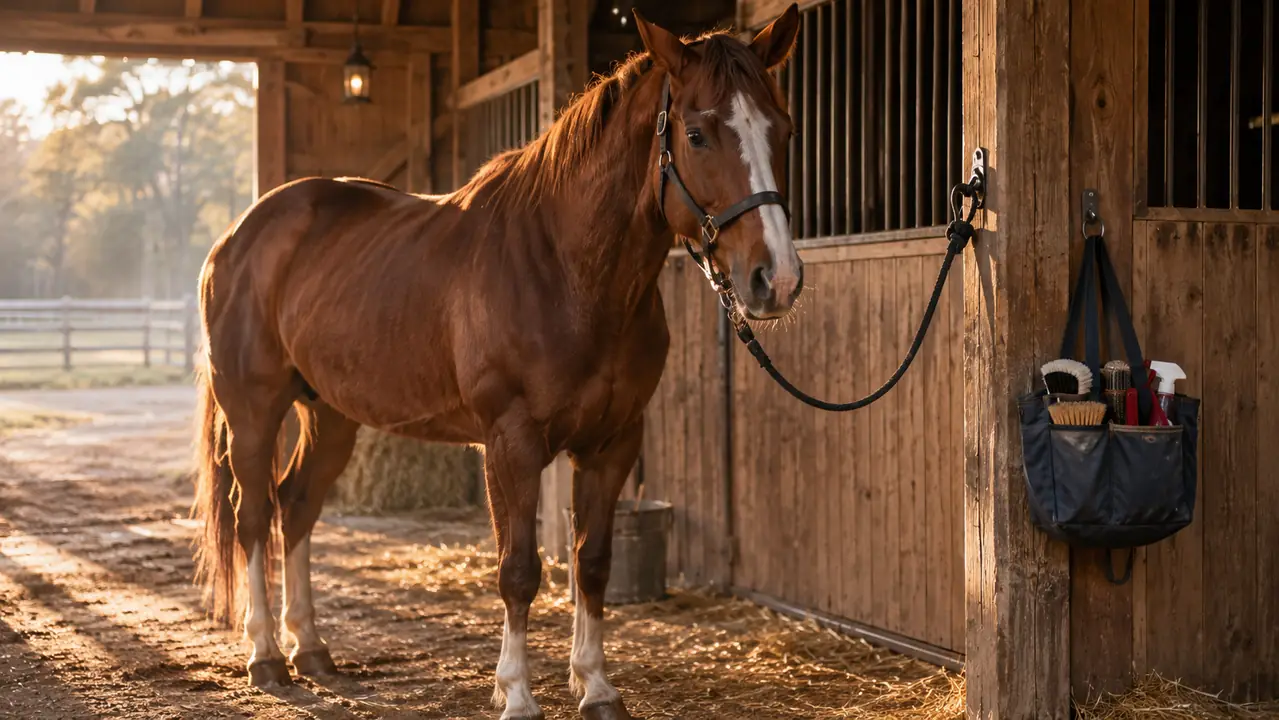
There is a version of getting ready for a trail ride that looks efficient and is not. You lead the horse out of the dry lot, drag a brush over him three times, pick up his feet in a hurry, and drop the saddle on. Twenty minutes later you are off him on a gravel road, digging a burr out from under the pad and wiping grit off the girth line, doing at the trailhead what would have taken ten unhurried minutes at home. I did that for years. What fixed it was not discipline and it was not me getting wiser. It was having the right handful of tools hanging in one place by the barn door, where I could reach them with one hand without thinking about it.
Since early June I have used the Weaver Equine 7-piece grooming kit with tote bag, and it is the first time in thirty years of keeping a horse that every brush I own lives in one bag. What is in it is a comb, a hoof pick, a mane and tail brush, a palm-held curry comb, a palm-held face brush, and the tote itself. That is the whole lineup I reach for, and I have not once gone looking for something that was not in there. The bag has six outer pockets and webbing handles, and it hangs on a hook just inside the barn door where it has hung since the day it came out of the box. Ranger gets the same order of business every time, and the whole thing takes about ten minutes.
Ten Minutes of Grooming Starts With Every Brush in One Place by the Door
The Weaver Equine 7-piece kit is the exact lineup I use before a ride, tote included. It has 4.7 stars across 3,592 ratings, and mine has been in daily use since early June.
Amazon Check Today's Price on Amazon →The Order That Actually Matters
Grooming is not scrubbing. It is a sequence, and when you get the sequence right the horse stands quieter and you finish faster. Dirt comes off in layers: the loose dirt and dried sweat first, the fine dust second, the face last, and the feet whenever you can get them without a fight. Here is the order I use and the reason behind each piece of it.
Step 1: Tie Him Safe, Then Pick Up His Feet
Feet come first, before a brush ever touches him, because a sore horse will tell you while you are still calm and unhurried instead of while you are cinching up. I tie Ranger with a quick-release knot to a post in the aisle. A hard tie, one you cannot free with a single pull, is how horses get hurt standing still. He wears the Weaver Equine padded nylon halter for this, and it has been his everyday halter for two years now. It goes on for catching, grooming, tying, the farrier and loading in the trailer, and it comes off before he goes back out. He is never turned out in a halter and never left in a stall wearing one, and that is not a grooming rule so much as a rule I do not bend.
The hoof pick is the piece in this kit I use hardest. I work from the heel toward the toe, clean the sole and the clefts beside the frog, and look at what comes out, because what comes out tells you something. Ranger is shod in front only and our farrier is out every six to seven weeks. If I find heat, a bruise, or a spot that makes him flinch away, that goes to our farrier. I am not the one to diagnose it and I do not try to. What I can do is notice it on a Tuesday instead of discovering it at the trailhead on Saturday, which is the entire argument for picking feet before you brush.
Step 2: Loosen the Dirt With the Curry Comb
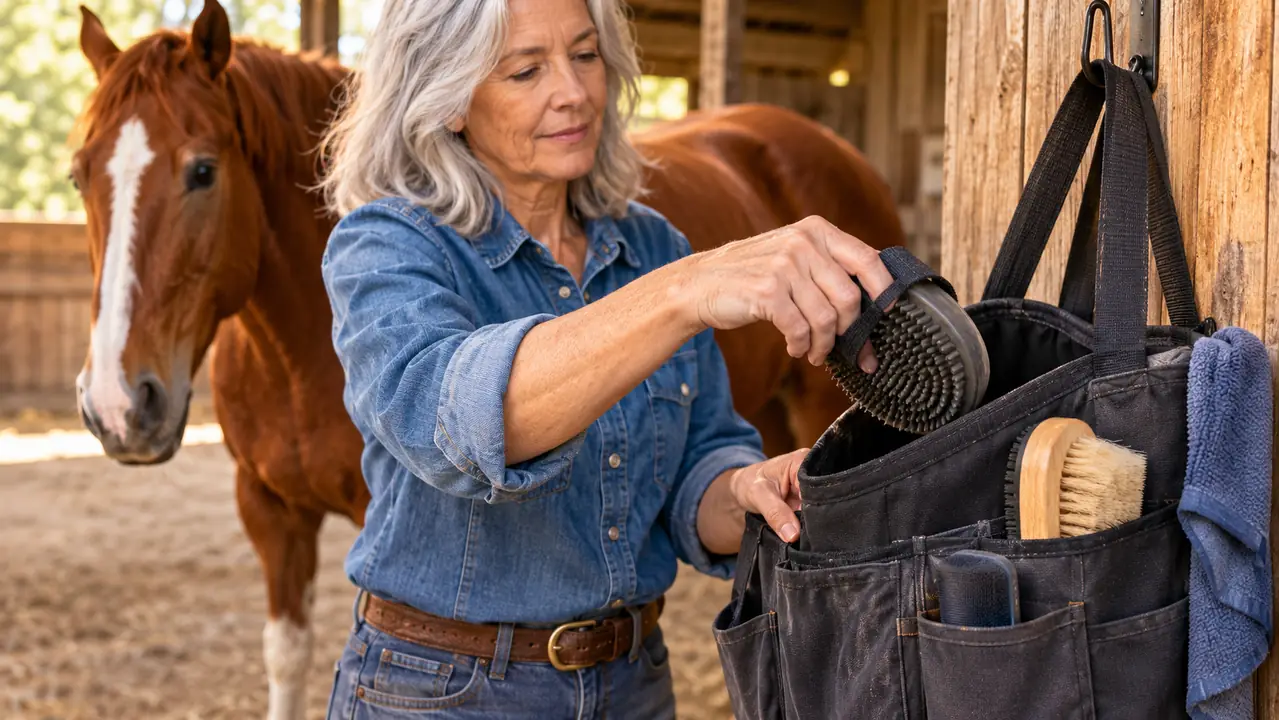
The curry comb in this kit is palm held, which means it sits flat in your hand rather than hanging off your fingers. I expected to dislike that and I do not. You feel the horse's back through it, so you ease off over a sore spot instead of grinding straight across it. I work in circles, with the hair and then against it, over the big flat muscle groups: the shoulder, the barrel, the hindquarter, the neck. I keep it off the spine, the point of the hip and the point of the shoulder, where there is nothing between skin and bone to cushion the pressure.
The dirt comes up in a gray haze, and that is the point of it. Curry first, always, because the curry lifts dirt out of the coat and anything you do afterward is just moving loosened dirt around. In June, when he was slick, this took two minutes. It is November now and he is growing his winter coat, thick enough that the curry comb is the only thing in the bag that reaches the skin. He sweats hard in an Arkansas summer, and the dried sweat along his neck and under the pad area is what the curry is really for. A brush alone will not touch that.
Step 3: The Face, With a Soft Brush and a Still Hand
The palm-held face brush is the piece most people skip, and it is the piece the horse notices most. A body brush on a horse's face is like someone rubbing your cheekbone with a scrub brush, and they will tell you so. This one is small enough to hold in your palm and soft enough to use around the eyes, the ears, and down the front of the muzzle where the skin is thin. The trick is to hold the brush still and let Ranger move his head against it instead of chasing his head around with the brush. Horses lean into a soft brush once they trust it is not going to poke them.
Two things I check while I am up there. Eyes first: if they are watering or he is rubbing his head on the fence rail, that is a fly or a dust problem, not a brushing problem, and it is worth solving. It is also the reason he wore a fly mask through the whole season, on at morning turnout and off at evening feeding, never overnight and never while being ridden. That went into a feed sack for the winter in mid-October. Ears second: I look, I do not dig. Whatever is in there is not something I am going to fix with a brush.
Step 4: Mane and Tail From the Ends Up
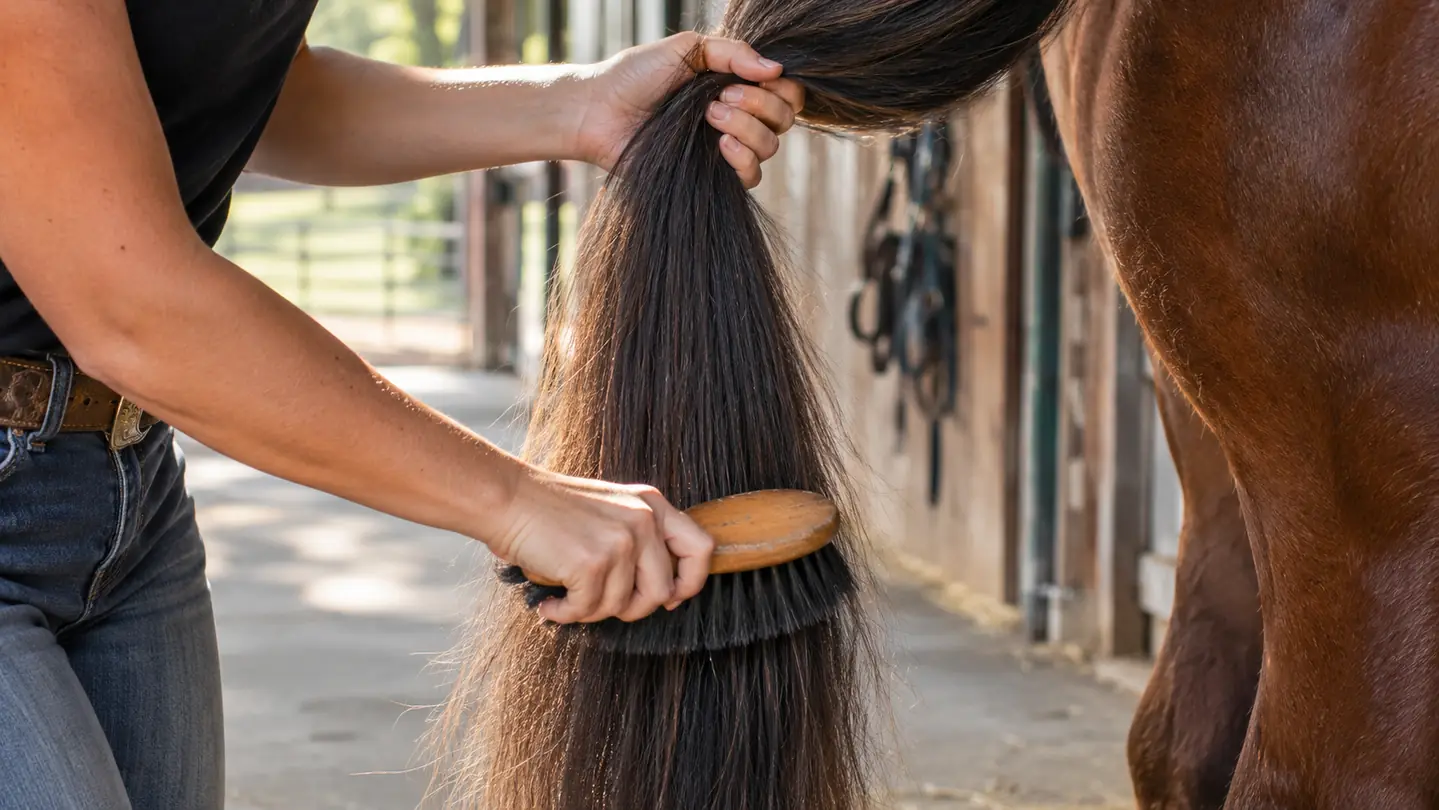
The mane and tail brush and the comb finish the body work. For the tail I start at the bottom and work upward in small sections, holding the tail above my hand so I am never pulling against the dock. Working top down is how you rip hair out and leave a horse tail-shy for a month. For the mane I use the comb on the thin places, the forelock and the short hair behind the ears, and the brush through the length of it. The comb is also the piece that gets the mud out of the base of the mane after a wet week.
This is where the burrs come out too. If he has been pushing through the scrub along the fence line, the burrs will be in the tail and the lower mane, and they come loose easier if you work them apart with your fingers first and let the brush handle what is left. I do not pull his mane, I do not trim anything, and I do not braid before a trail ride. We are going out on Forest Service trails and gravel roads, not into a show ring, and nobody on those trails has ever cared that his mane is uneven at the bottom.
Five months of nearly daily use, and the only maintenance this kit has needed is a bucket of warm soapy water and a sunny spot to dry.
Step 5: The Last Pass, the Four Places That Rub
The last thing before the saddle goes on is a pass over the four places that rub, and I do it with my hand rather than a brush, because a hand finds what a brush smooths over. Under where the pad sits. The girth line behind the elbow. The belly where the cinch runs. And the flank where the hind leg swings forward. Any grit left in those four places turns into a sore by mile three, and a sore is not something you can fix on the trail. If I find dried sweat down in any of them, the curry comb comes back out.
Then the saddle, which has nothing to do with grooming except that it has everything to do with it. Ranger is girthy. He pins his ears if the cinch comes up tight in one pull, so I tighten in three stages, walking him a step between each one, and I check that the pad is sitting flat with the hair under it lying the right way before I get on. My saddle and pad are older gear I have had for years and I am not going to pretend they are the newest thing in the barn. They are clean, they fit him, and I check the leather before every long ride.
What Else Helps
About once a month the brushes get washed. Warm water, a little soap, worked through the bristles, rinsed, then set bristle-down in the sun to dry, because a brush left bristle-up sitting in water goes soft and sour at the base. That is the only maintenance this kit has needed in five months. The bristles are horse hair and the handles are nylon, and they have held up to a wet horse, a dusty horse, and being hauled in a trailer behind the pickup once a month. The tote measures eleven inches long, ten wide and seven tall, weighs under three pounds empty, and holds everything with room left over in the six outer pockets for a rag and a sandwich. It has 4.7 stars across 3,592 ratings, which strikes me as about right for a bag of brushes that does what a bag of brushes should.
A couple of other things earn their place in the routine. The padded halter is the one piece of gear Ranger wears every single day of handling, and after two years it has faded some and the padding is flatter, but no stitching has failed. My riding gloves matter as much for leading as for riding: before I had them, the long summer group rides left me with raw spots between my ring and little fingers from the reins, and that has not happened since. Hand wash only, air dried on the tack room windowsill. None of that is grooming, strictly. All of it is part of the same ten minutes.
One more thing, and then I will get out of your way. The ten minutes only works if the tools are where you can reach them. Mine hang on a hook by the door, and the reason the routine held through a whole Arkansas summer is that I never once had to walk to the tack room to hunt for a brush. If your kit lives in a bucket in the corner under three other buckets, fix that before you fix anything else about how you groom.
The Brushes I Reach For Five Times a Week, All in One Bag
Comb, hoof pick, mane and tail brush, palm-held curry comb, palm-held face brush, and a tote with six pockets. That is the whole routine. Mine has been in the barn aisle since June.
Amazon See Current Price on Amazon →