
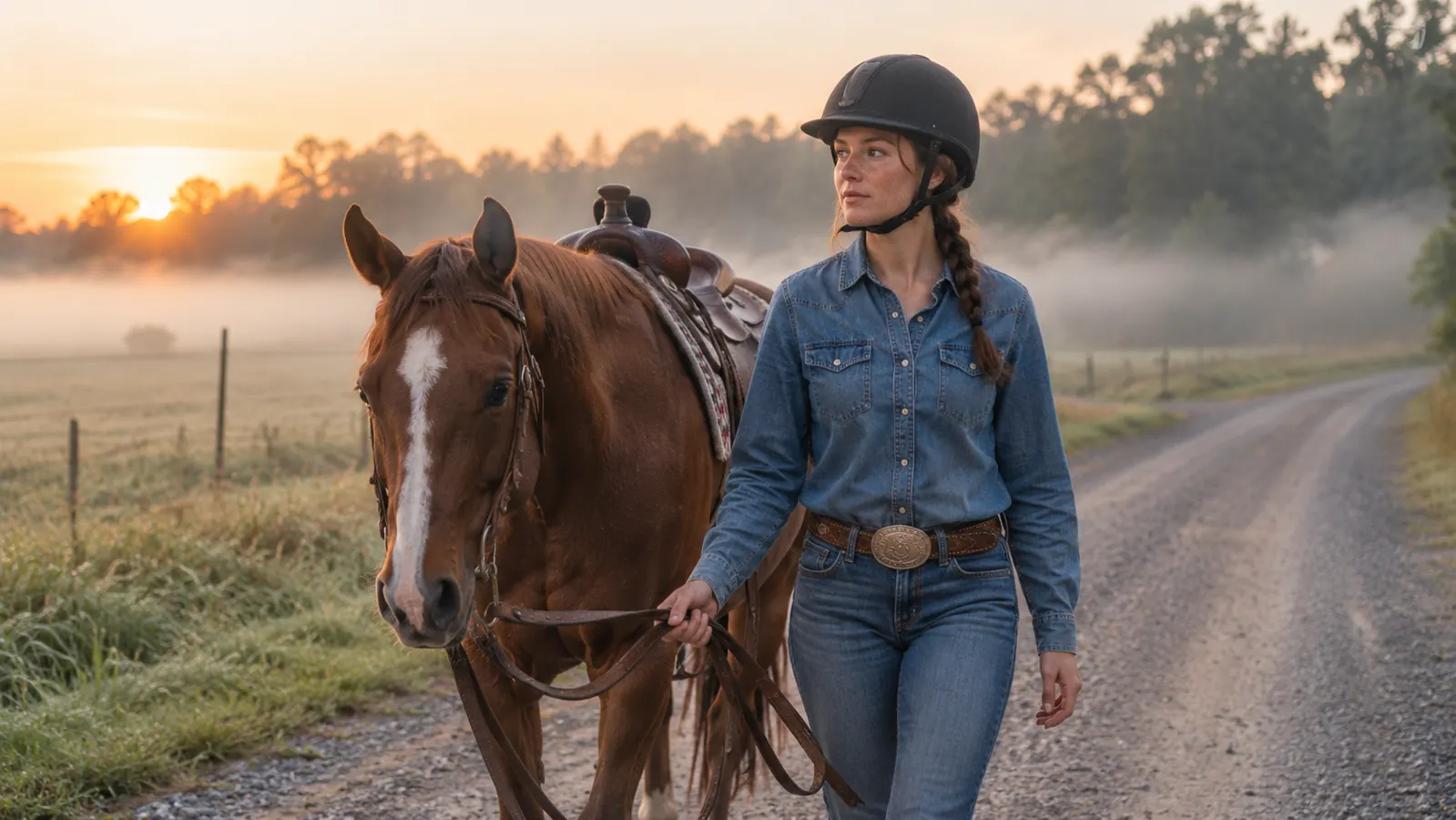
I wore a felt cowboy hat for the better part of thirty years and told myself that was enough. Then on a Saturday in the middle of March 2026, Ranger spooked at a deer that jumped out of the brush along a gravel road, and I came off sideways into the ditch grass. I bruised my left shoulder and my left hip. I did not hit my head. My friend Bonnie rode up, looked at me sitting there in the weeds, and said the plainest thing anybody has said to me in years, which was that it could have been my head. Three weeks later a Troxel Spirit Duratec arrived in a box on my porch. This is the honest version of the seven months since, including the parts that are inconvenient for the helmet.
Plenty of reviews will tell you this is a nice helmet and leave it at that. That is not much use when you are sixty-one years old, sitting on a bale in the barn aisle, trying to work out whether the thing on your head is on right. What follows is what I actually ran into after about eighty rides, three or four a week on Ozark gravel and Forest Service trail, plus the one longer group ride a month that I trailer Ranger to. I am not a trainer and I am not a vet. I am a woman with one horse, a tack room at the end of the barn aisle, and a hook that helmet hangs on.
The Quick Verdict
A light, well-vented, full-coverage helmet that asks you to measure your own head and then stays put. Buy it for the fit and the airflow. Do not buy it expecting features the listing never claims, like a crank or a washable liner.
Amazon Check Today's Price →The helmet that finally got me out of a felt hat at sixty-one
Seven months of daily trail use on Ozark gravel and Forest Service roads, with the vents and the full coverage doing the work I needed. Sizing runs off your own head measurement and the Troxel chart, so do that part before you order.
Amazon Check Today's Price on Amazon →What Nobody Tells You Before Your First Helmet
The first thing nobody tells you is that a helmet changes how you ride before it ever protects you. For the first three rides I was stiff as a board and my seat went cautious, and Ranger read every bit of it. He is a calm horse, but he is herd-sour leaving the barn and he is not above taking advantage of a rider who is thinking about her head instead of her horse. It evened out by the second week. I am telling you because I nearly parked the thing around ride three, and if you are coming to this late like I did, you will feel the same thing, and it is not a sign that the helmet is wrong.
The second thing nobody tells you is that the fit happens at the kitchen table, not at the barn. There is no one out there to check it for you. I measured my head with the sewing tape I keep in the tin with the buttons, wrote the number on the back of an envelope, and worked down Troxel's size chart until I landed on a Large. I will not give you the number, because my head is not your head and the entire point is that you do your own. Skip that step and guess, and you get a helmet that sits wrong, and a helmet that sits wrong is a helmet you will find reasons not to wear.
The third thing is that you will feel foolish, and you should know that up front. I have ridden since I was a girl. Half the people I ride with still go out in hats. Putting a helmet on the first time felt like announcing that I had decided I was bad at my own hobby. That feeling lasted about two rides and it has not come back, even when I am the only one in the group wearing one. Bonnie still rides in a hat. She is the reason I have the helmet, and she knows it, and we do not talk about it.
How I've Used It
Seven months now, since the first week of April 2026, and roughly eighty rides. It hangs on a hook in the tack room at the end of the barn aisle, next to the bridle, where I can grab it with the same hand that grabs the reins. In cold weather I wear a thin cotton skull cap under it and nothing under it the rest of the year. It goes on before I lead Ranger out and it comes off after I have untacked and wiped the bit. That is the whole routine, and the routine is part of why it has held up. It lives inside. It does not sit on a fence post in the sun. It does not ride around in the floorboard of the truck.
The weight is the part I notice least, which is the point. The listing puts it at 1.1 pounds and I have no reason to argue with that. What I notice is the vents. Arkansas in July is a wet shirt by eight in the morning, and Ranger sweats heavy, so we are both miserable by the same hour of the day. The airflow through the shell is the difference between a helmet I pull off at the trailer and one I forget I am wearing until I am halfway home. The outer is polycarbonate and the inner is expanded polystyrene, per the listing, and the finish has taken being set down on a tailgate without cracking or crazing.
Most of my riding is alone, an hour and a half, out the back of the pasture and onto the gravel road. Once a month I load Ranger in the two-horse bumper pull and meet friends at a trailhead for a longer ride, and that is where a helmet earns its keep in my mind. Four hours in the saddle, unfamiliar ground, a group of horses who do not know each other yet, and me on a horse who gets herd-sour when the group strings out. Nothing has happened on those rides. That is rather the point of the thing, and I would rather carry it than explain to Earl why I did not.
The Fit Is the Whole Thing
The listing calls the adjustment an adjustable strap, and that is the honest description of what I use. It is a strap. If you are expecting to fine-tune the fit with a crank on the back, this page is describing something else, so ask before you order rather than after. You set the length once and then it is the same every time, which suits me because I am not fiddling with hardware at the trailer in the dark. The low-profile part of the description is about the shape of the shell, and it sits close to the head rather than standing up off it. On a hot day that matters more than it sounds like it would.
Full coverage is the other half of the fit question, and it is the reason I chose this helmet over a plainer one. The back of the shell comes down over the base of my skull and the sides come down past my temples, so I am not sitting there on the trail wondering what is not covered. Troxel sells this same helmet in a range of graphics and colors. I chose the plain end of that range on purpose, because I did not want to be thinking about how it looked while I was putting it on. The limited one-year warranty is the sort of thing you hope never to use, and so far I have not.
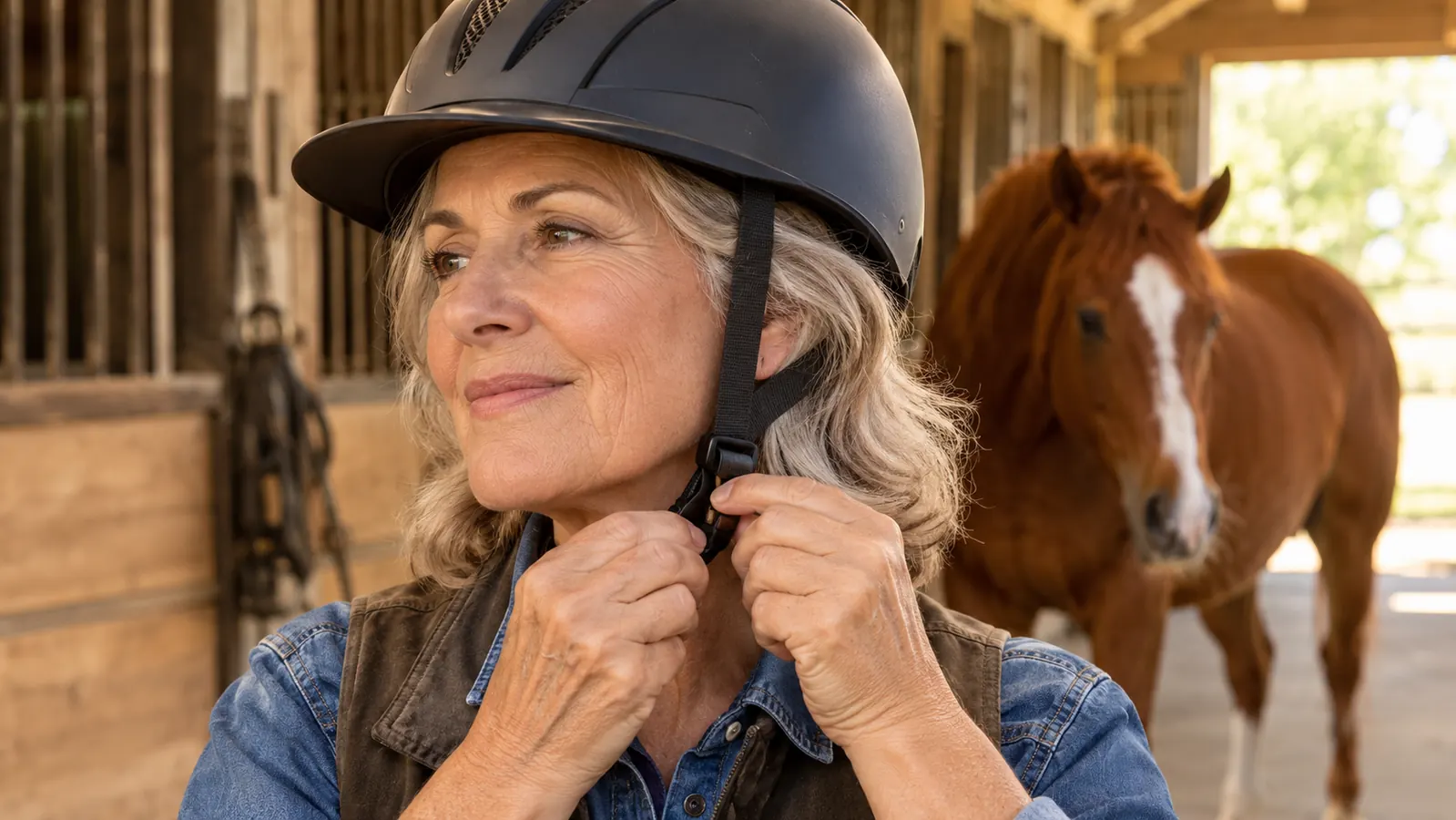
It is worth saying plainly that a helmet is not a snug cap and it is not supposed to be. Mine sits level, front to back, with the front edge where I can see it under the brim line of my own brow. The first time I put it on I had it tipped back like a feed cap and it felt loose and wrong, and that was my error and not the shell's. Take a photograph of yourself in it with your phone before you decide anything. I did, felt silly doing it, and it was the fastest way to see that I had it on backwards in spirit.
What I Liked
- 1.1 pounds is light enough that I stop noticing it by the second mile
- The vents move real air, which matters in an Arkansas July
- Full coverage down the back of the skull and past the temples
- The adjustable strap has not slipped once in seven months
- Low-profile shape, so it does not feel like wearing a bucket
- Limited one-year warranty, and a brand that has been at this a long time
Where It Falls Short
- The fit is decided once, at the kitchen table, with a tape measure and a size chart
- The listing does not mention a removable liner, so I wipe the inside rather than wash it
- The chin strap took two hands for the first several rides
- No crank or dial is described on the listing, so check that before you buy
- It does not shade your face and neck the way a felt hat did
- It does nothing at all if you leave it on the hook
Seven months and about eighty rides on Ozark gravel, and the strap still holds exactly where I set it in April.
What It Does Not Do
Here is where I will not do the helmet any favors. It does not make Ranger any less spooky. It does not fix a bad seat or teach you to sit a spook, and it will not stop you from coming off. It does not cover your ears in January, which is why the cotton skull cap exists. And it has not been tested by me in a fall, because seven months in I have not had another one, and I am not going to invent a story to make a review read better than the truth does. What I can tell you is what it has done on eighty ordinary rides, and that is all.
It also does not keep the sun off your face and neck the way a felt hat does. I noticed that inside the first week, because I had traded shade for protection and had to start carrying sunscreen in the saddlebag and a bandana around my neck. If you have ridden in a hat your whole life, that trade is real and it is the one thing I grumble about in July. The rest of the year I do not think about it at all.
And it does not answer the standards question for you. The listing page I bought from does not spell out a certification line for me to repeat back to you, and I am not going to make one up. If you show, or compete, or board somewhere with rules about what is allowed in the arena, ask Troxel directly before you order rather than taking my word or anybody else's. For trail riding alone on gravel roads, the judgment I made was that a well-fitting helmet I will actually wear beats a better one hanging on a hook, and I still stand behind that.
The Small Things That Decided It for Me
The chin strap took two hands for the first several rides and now takes one. I run it in front of my ear, buckle it, and take up the slack until I can get two fingers under it. That is how I was taught and it is what I do every time. In seven months the buckle has not slipped, which is more than I can say for the strap on the work gloves I used to ride in. A loose strap is the most common thing I see on other people's helmets at a trailhead, and it is free to fix.
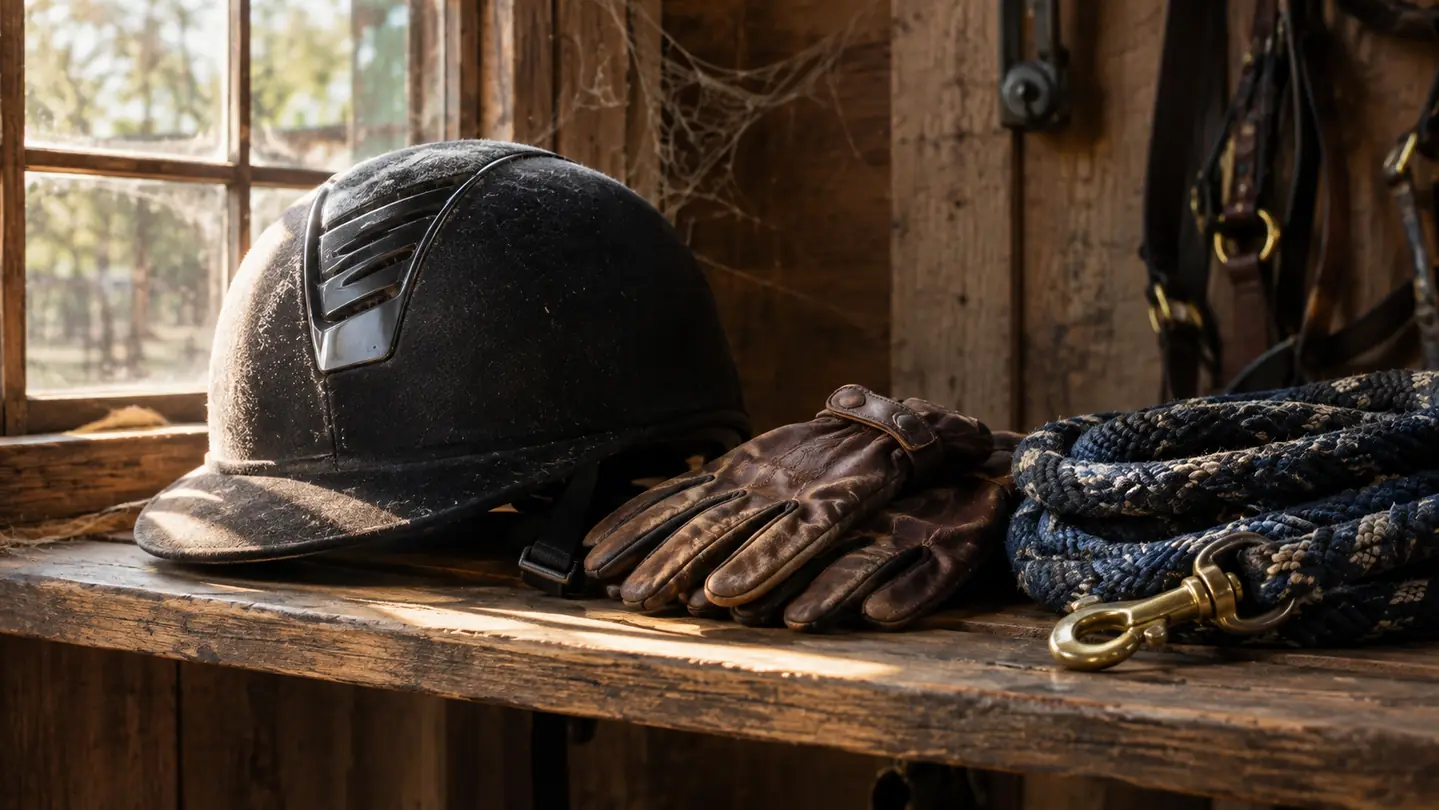
The hook decided it too, and I would tell anybody buying a first helmet to pick that spot before the box arrives. If this thing had needed a bag, or a shelf, or a clean spot on the truck seat, it would have ended up on the barn floor getting stepped on, and then it would have been a nuisance instead of a habit. My tack room has a row of hooks and one of them is now the helmet hook. The saddle, pad and bridle are older gear and they have their own places. Everything I need to ride is within arm's reach of the door.
Keeping It Clean and Keeping It on Your Head
Maintenance is about thirty seconds a week. I wipe the inside of the shell with a damp cloth and set it back on the hook to air, and that is the whole job. The listing does not mention a removable liner, so I treat the inside as fixed and clean it in place rather than pulling anything out. The skull cap in cold weather helps more than you would think, because it keeps hair and grit out of the shell and it washes in the sink with the dishcloth. The outside gets a wipe when it looks dusty. I have not used any cleaner on it stronger than a damp rag.
One habit worth borrowing: I never set it on the truck dash or the tailgate in the sun. Heat and sunlight are hard on the materials, and it costs nothing to carry it inside. The other habit is duller but it is the one that matters. Put it on before you mount, every time, including the short ride you were not going to bother with. The fall that started all this happened on a gravel road I have ridden a thousand times, twenty minutes from the barn, on a horse I trust. There was nothing special about that Saturday except the deer.
Who This Is For
This is for the rider who has been at it a long while and never wore a helmet, and who has finally decided that is a silly thing to keep doing. It is for trail riders who want full coverage without a heavy, hot, bulky feel on their head for four hours. It suits somebody who will take five minutes with a sewing tape and a size chart and get the size right the first time. If you ride alone on gravel roads and county lines the way I do, with nobody around if something goes wrong, this is a sensible place to start. And if you are a little embarrassed about buying one at this stage of your life, I was too, and it passes.
Who Should Skip It
Skip it if you are not going to measure your head. Guessing the size on a helmet is the same as not buying one, and I would rather you spend the five minutes than the money. Skip it if you want a crank to fine-tune the fit, since the listing here describes an adjustable strap and you should confirm anything beyond that with the seller first. Skip it if you need it for competition and your rules name a standard this page does not spell out. And skip it if you already know, honestly, that it will live in the tack room and you will keep riding in a hat.
If you have been riding in a hat, this is the one I would start with
Measure your head with a soft tape, follow the Troxel size chart, and hang it where your hand already goes. That is the entire system, and it has held for seven months and about eighty rides on Ozark gravel.
Amazon Check Today's Price on Amazon →